Adam Reger | Freelance Writer

Philadelphia-based freelance writer

Free Box, Installment #3: More Free Ideas

Here’s another installment of Free Box, explained here and then continued here.

Free ideas:

-Adultery drama where woman ostensibly being cheated on is actually in league with her husband—as spies for a terrorist network, destabilizing diplomatic circle by carrying on multiple affairs, affecting trust in this tiny, close-knit community.

-A man’s allergies are key to unlocking the meaning/secret of life. Or, to finding some hidden treasure. [What? I don’t know either.]

-Professional wrestler is injured in big pay-per-view match, paralyzed. He has to struggle with his newfound limitations while providing for his family and negotiating tricky relationship with the league, which is keeping him on the hook by paying him to be part of its storylines. Discrepancy between his anger and public displays.

-Group does hauntings for a fee: they’ll fake ghosts, allowing their clients to suggest a meaning for the haunting: e.g., “She must be upset about your will giving me so little,” etc. Complication when a real ghost shows up.

-Man has power to teleport himself by going to sleep and visualizing moving across space in his dreams. Sought after by government agents, others, develops new, even more powerful abilities.

-Banshee fitting in to real world, called upon to act as a hero.

Yikes. Not the best ideas I’ve ever had. I haven’t mentioned before that for a while I was challenging myself to write a page’s worth of ideas every day, and that’s what these first few batches of ideas are. So, some are better than others.

Reason #10 to Love Pittsburgh: Pittsburgh Filmmakers; and, More Than You Wanted to Know about My Relationship to “Down By Law”

I’m astonished to learn that I’ve never cited Pittsburgh Filmmakers, the local arts organization that provides various kinds of film education as well as showing films in three locations, as a reason to love Pittsburgh. It is way, way up there on my list of reasons that I love Pittsburgh. As a student, they sold me cheap tickets to excellent movies. (I well remember going to the first movie I saw there, Night of the Hunter.) As an unemployed person who still possessed a valid student ID that doubled as a bus pass, busing it down Forbes Avenue to check out great movies (again, I stress the cheap ticket prices) at their Regent Square or Harris branches was a great pleasure, and a relief from a time of uncertainty and, in retrospect, great boredom.

I’ve seen The Warriors thanks to Pgh Filmmakers. I got to see Sunrise, twice, because of them. At a promotion for their “movies of the Great Depression” series, they raffled off Fiestaware and I won this awesome pitcher at a screening of Gold Diggers of 1933:

Image


Beasts of the Southern Wild was a big stinking turd of a film, but that’s not their fault. Every year they screen a slate of Oscar-nominated short films, including live-action, animated, and documentary. Truly, their programming is inventive and always surprising, and it’s been rare that a month has gone by without my heading to one of their three theaters to check something out.

Among the reasons to love Pgh Filmmakers is their astute balance of newish art-house and foreign films with old repertory stuff. This month, the theme is film noir. Last month, it was Hitchcock’s women. (This Sunday, they’ll show Out of the Past.) The repertory films are always on Sunday nights, and it can be fun to cap your weekend with a well-attended, high-spirited showing of, say, Whatever Happened to Baby Jane? (Great memory from that screening: during the scene when Baby Jane brings Blanche her lunch in a silver tray, and it’s been hinted at that there might just be a dead rat under that platter, someone in the back of the theater yelled out, “She wouldn’t . . . would she?” It’s one of the few times I’ve enjoyed anyone’s heckling.)

Rarely, however, have I been as pumped for a series or a particular screening as I am today, because tomorrow night they are showing one of my all-time favorite films, Down by Law. It’s part of a new series, “Essential Art-House Cinema.” Tickets are–get this–$2! The series kicked off last month with Run Lola Run and I think it is just about the best thing happening right now.

I’ve never seen Down By Law on the big screen. My first memories of it are as a high school junior or senior, catching part of a Bravo mini-marathon of Jim Jarmusch films. I was immediately taken by the black and white cinematography and the beautifully composed images of New Orleans and the swamps of Louisiana, as well as the amazing long shot where the three characters run through a tunnel, culminating in an extra-long hold on a puddle reflecting light onto the tunnel’s ceiling. (It’s an effect that always mesmerized me when I caught the reflection of light moving in a fountain, or a pool, and so it stood out as one of those artistic decisions–to take what everyone has seen and represent it in the work–that feels both obvious and ingenious.) Here’s the shot:

Image

It’s hard to remember now if Down By Law was my entry point into really liking Tom Waits, who plays Zack, a DJ, in the film, or if I’d already been interested in the Tom Waits persona and that drew me into an obsession with the movie. My entry point into the Waits oeuvre is hard to untangle now: it seemed that my dad played Franks Wild Years throughout high school, that I was always hearing Waits’ discordant crooning on songs like “Straight to the Top,” “I’ll Take New York,” and even “Down in the Hole” (though it’s been somewhat rehabilitated in my eyes via The Wire, for which it was the opening music) wondering what the hell this was. At some point the beautiful songs interspersed throughout that album–“Telephone Call From Istanbul,” “Blow Wind Blow,” “Yesterday Is Here,” and most memorably for me, “Cold Cold Ground”–sank in, and I came to appreciate that this was actually a pretty decent album. My appreciation deepened when I went off to college: I can remember getting into Rain Dogs (two songs from which, “Jockey Full of Bourbon” and “Tango ’til They’re Sore,” accompany the opening and closing of the movie; check out the trailer, which is pretty much the opening montage of Louisiana places, with “Jockey Full of Bourbon” accompanying it) and Swordfishtrombones heavily once I was at college, and toward the end of that year checking out Bone Machine. Those are still my favorite albums of his–I’ve never gotten very far into the early, barroom troubadour type stuff, though it’s interesting to listen to the clever songwriting and hear the foundations of the weirder, more inventive songwriter who would emerge–and they’ve informed my appreciation of Waits. . . .

Wait, what was I talking about?

Whichever came first, as a late-teenager I was entranced by the Zack character. Embarrassingly, I can remember buying suspenders from Value City and a cheap tweed Totes hat from a thrift store in order to emulate him; I seem to recall being home for the summer from college and picking up my brother, a sophomore, from high school and him demanding furiously that I take that hat off. For me Zack, with some of the movie’s most memorable lines, is the centerpiece of the movie. But it feels like an ensemble piece, with John Lurie as Jack and Roberto Benigni as Robert (or just Bob), the sort of movie where people might reasonably differ on who is their favorite, who seems to be the heart of the film. (Regrettably, identifying oneself as a Zack, a Jack, or a Robert never caught on the way that classifying oneself and others as a Sex and the City character did later.)

The film’s plot is minimal. Looking over the results of my image search, thinking about that semi-obscure title (from a bit of old slang that Jarmusch has said had evolved, by the ’80s, to mean that you were close friends with someone), considering the choice of two musicians and a then-unknown Italian comedian for the lead roles, Down By Law feels somehow like Jarmusch’s attempt to make one of those loosely plotted, kinetic European films, by Fellini or Godard, that would have informed his education as a director. I should also note how glad I am to have come to the movie almost 15 years after its release; reading John Pierson’s great Spike, Mike, Slackers and Dykes around that time, I got the sense that critics dismissed Down By Law as too similar to Jarmusch’s first feature film, Stranger Than Paradise (which is also great; here is a trailer (with Japanese subtitles); one thing that can never be said about Jarmusch is that he has no sense of how to use music in his movies), and Jarmusch as a one-trick pony. That’s baggage I’m glad never to have had.

 . . . Anyway, at this point I’m rambling. My object in writing all this is to extol Pittsburgh Filmmakers to the extent that it deserves, and to let anyone in driving distance know that they’ll be screening a fantastic film Wednesday night. 8 p.m.
Free Box, Installment #2: Novel Appendix

Part of what I want to use this feature, Free Box, for is to post old stuff that’s moldering in my filing cabinets and on various disks and computer drives, that will never be published and would be more fun to share now than when someone is going through my papers after my death. (Free Box #1, with an explanation, is here.)

To that end, here’s a blog entry that I posted about two years ago. Here’s the piece of writing I’m putting in the free box (with a warning that there is some strong language and content in this piece). The blog entry gives fuller context, although I’m not sure anything could properly explain where this came from, in the sense of what I was thinking at the time.

Sentences from News Story on Boston Marathon Bombing Suspects Rendered as Prose Poetry

From several of the more prosaic sentences in this Wall Street Journal piece about the two suspects in the Boston Marathon bombing, I’ve constructed what’s either a prose poem or a piece of flash fiction. Here it is:

“A Look at the Brothers”

By Alison Fox, Sara Germano, Siobhan Gorman, Evan Perez, and Adam Reger

On the table in front of the two young men is a chicken dinner, ranch dressing and a jug of orange juice in a room that resembles a dorm kitchen.

Others started sending him “photographic gifts” on the site that included police cars, sticks of dynamite and, in one case, a brick.

The date of the photos wasn’t clear.

Attempts to reach the photographer were unsuccessful.

A second uncle also lives in the area.

There are quite a few auto-body shops.

Have a great weekend, everybody!

The Thrilling Case of the Pitt Druids

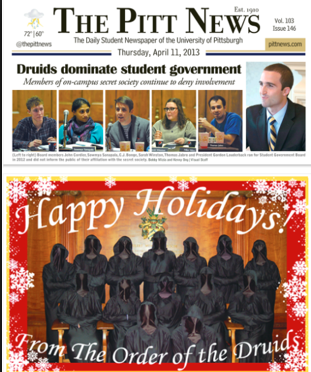
An interesting thing that’s been happening at the University of Pittsburgh these last few weeks is the unfolding revelation of the on-campus activities of the Druids, a secret society that’s been at Pitt some 90+ years.

Things kicked off with this pretty-excellent-for-a-college-newspaper expose in The Pitt News, revealing that a number of members of Student Government were Druids but had not disclosed that information. In a sidebar to the article, it was revealed that Nick Stamatakis, assistant opinion editor for the paper, was himself a Druid. The problems with this were that he had not disclosed this fact to the paper’s editor-in-chief, and had written the paper’s editorial endorsing their preferred candidate for student president—that candidate turning out, in fact, to be a Druid.

Stamatakis was spared for a few days but then was fired. The story has gotten picked up a few different places.

I work at Pitt, and it’s been fascinating to see Pitt News covers like this one on my way to work in the morning:

Image


It’s also been enlightening to read about what the Druids do—not a whole lot, and absolutely nothing sinister*, so far as I can tell—and to contrast it with the stuff I used to read, circa 2000-2004, about George W. Bush and his involvement with Skull and Bones at Yale. Maybe it’s a certain nostalgia in former Skull and Bones members recounting their clandestine deeds, maybe people took these things a little more seriously in those days, maybe Ivy Leaguers just did the skullduggery thing with a little more panache. I’ve got a hunch, though, that it’s partly my being older than the secret society members in question, and tending to view them as being not that mysterious, and usually feeling I can understand their motivations, which is how I usually feel toward college students in general. (Let me be more precise, because I don’t mean that I know what today’s college student is thinking; I certainly don’t. I mean that I can remember what it was like to be between phases of life, to have an excess of freedom and not know what to do with it, to be overconfident, jaunty, and whimsical and to have all that predicated on not knowing what the hell was coming down the pike. Which is to say I look at these photos of the Druids in their cloaks and imagine the nerds inside the hoods, adrenaline pumping at how amazing they are being, when in fact, the Druids are really just a secret networking clique that taps high achievers.)

*Okay, this is pretty weird, I’ll grant you:

Image

Free Box, Installment #1

Here is a new feature I’ve been meaning to roll out for some time now. Last spring I had the idea to generate tons of ideas for novels, stories, and films every day, with the intention of starting an “idea factory” wherein I’d then contract writers, via elance or Craig’s List, to flesh out those ideas.

For various reasons—chief among them a reluctance to spend my money this way and a writer’s proprietary feeling toward his ideas—my idea factory closed down. But since then I’ve revisited some of my ideas and realized they’re not at all bad, and that for the right person they might be helpful. I’ve also noticed that I have plenty of ideas for other things, in fields like business, that for various logistical reasons I am never going to put into action.

So I decided to create a space on this website where I can put these things out, free to anyone who wants them: a “free box,” like you’ve probably got at work, or in your apartment building, or like I used to find in my dorm buildings while at college.

No strings are attached to any of these ideas, although I’d like to ask that if you find something here that is useful to you, you let me know (and especially if it ends up turning into a finished product of some kind). And if you take one of my ideas and turn it into a multimillion-dollar feature film, it would certainly be appreciated if you threw some of the royalties my way.

Anyway, here it is, Free Box Installment #1:

-Hoboes. Period piece. Bank heist: hoboes versus railroad bull and small-town sheriff who shot lead hobo down years earlier. Comedic but tense (in the vein of O Brother Where Art Thou?). Fading of hobo era—new high-speed trains are making it more difficult to jump onto trains. Ragtag bunch of hoboes pulls off big heist.

Haymarket-style detective story. Bomb is thrown, anarchist is wrongly accused. Amid outrageous bias, one honest cop discovers the truth, has to navigate tense 1880s climate along the way.

-Prison break. Dad has to escape to see his son play in the Super Bowl. Twin plotlines of father and son.

-Man who can walk through walls. Dishonest man uses this for evil, then good.

Storage Wars-type guy—a locker buyer—finds an urban treasure map supposedly leading to a famed treasure long since thought to have gone missing. Maybe shot in reality show fashion, with other contestants becoming involved along the way.

-Man in need of money goes on a game show—like either Jeopardy! or Wheel of Fortune—and competes using a special system he worked out using hours and hours of tape on that show. (Invent a show to suit the plot; base it on that “Whammy” show guy. [I meant Michael Larson, who successfully “cheated” on Press Your Luck in the 1970s.] He has to not only compete against other contestants but has to outsmart producers who know something is up. (Would need to differentiate it a bit more from Slumdog Millionaire.)

Harlem Globetrotters versus Washington Generals story. Crushing anguish and effects on team of losing every night, discrepancy between good guys on-court and off. Bad News Bears-type story, with Generals rallying to win one (and then being booed vigorously). [I’d be remiss if I didn’t plug my own short story here, “The Night the Washington Generals Beat the Harlem Globetrotters,” in cream city review.]

-Zero energy moment is reached, when there’s no more oil or coal. People think they’re ready but they’re not. Documentary style, following human-power impresario, solar proponent, wind person, etc. OR: when the lights go out, terror over uncertainty, no internet (no electricity), a serial killer is stalking the city. [Note: I have never seen the TV show Revolution but this sounds somewhat similar from having watched the promos. I definitely wrote this idea down at the end of last May, so please, NBC, do not sue me.]

There you have it, the first installment of Free Box. Not the greatest ideas in the world, but what do you want? They’re free.

Reason #9 to Love Pittsburgh: Billy Nardozzi and Pittsburgh’s Literary Underground

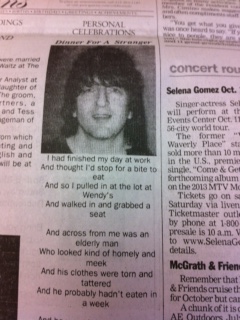
Today I was paging through the Pittsburgh Post-Gazette and saw this guy’s face in the section for paid announcements:

Image

It was the second time I’d seen Billy Nardozzi and his poetry in the Post-Gazette, and I thought, “What in the world?”

I did some research, and apparently he’s a known quantity here in Pittsburgh: NPR wrote a piece on him in 2011. That followed a Post-Gazette feature from 2009 by Brian O’Neill, a great PPG reporter.

Nardozzi drops $50 to $100 every Tuesday to have his poems published, along with a photo of himself with that ridiculous mullet and, at the bottom of each poem, his phone number, with a note beneath it saying, “((( All Calls Are Welcomed ))).”

Some people do call him, he said, many with words of encouragement and thanks, and others with advice to cut the mullet. Both pieces take pains to make the point that, no, this is not ironic at all. You’d be forgiven if you thought it were an elaborate joke, because these poems kind of stink.

I could explain why in detail, but instead, here’s a Tumblr of the poems of Billy Nardozzi.

Reading about Nardozzi reminded me of The Dirty Poet, a Pittsburgh fixture whose poems tend to appear overnight, yellow 8 1/2 x 11″ yellow sheets of paper taped to poles in Squirrel Hill, Friendship, Bloomfield, and other neighborhoods. This Pittsburgh Quarterly piece talks briefly to The Dirty Poet.

I met The Dirty Poet once, setting out his poetry at great Pittsburgh bar the Brillobox. He said to me basically what he said to the Pittsburgh Quarterly: that he gets more feedback on his poetry from taping it to phone poles than he ever has publishing in small literary magazines. (He was a little snide when he heard I was a writer, and asked if I’d published anything. I said I had, which occasioned his little soapbox speech.)

This New Yorker blog piece also namedrops The Dirty Poet as it extols Pittsburgh’s literary scene. As good a job as the writer does, I feel there’s an obvious indicator of the depth and richness of Pittsburgh’s literary culture that Ms. Macy Halford missed: Pittsburgh has not only a literary scene but a literary underground, populated by writers who so burn to be heard they bypass the machinery of that literary scene and pay to publish their work, and sneak out in the dead of night to tape their work to traffic poles (or, go out at 9 p.m. to distribute it at bars). That is what I call a literary culture.

Found Poetry from the Chicago Manual of Style

At my previous position, as a copy editor, I had a fair bit of downtime and access to the Chicago Manual of Style (15th or 16th edition for you grammarphiles who might be wondering). To pass the time and to make myself a better editor, I’d read through it until I started dozing off. Along the way I wrote down some of the more notable example phrases and sentences the Manual used to illustrate various grammatical principles. These are from all over the book, representing any number of grammatical rules.

I’ve given the poem my own title, but if you’ve got a better one, suggest it in the comments.

“The Onslaught of the Word”

We the voters will decide
Children, stop misbehaving
A limo carried the band
I hoped to see many deer, but I saw only one deer

The governor delivered a speech
The shops are crowded because the holiday season has begun
The troops retreated in winter
High in the tree sat a leopard

My show dogs are Australian shepherds
The balloon carried a pilot and a passenger
Place the slide under the microscope
The queen consulted the prime minister

Everything else was returned; the medicine the villain withheld
An assembly of strangers was outside
George Washington, our first president, was born in Virginia
Robert Burns, the poet, wrote many songs about women named Mary

The husband has worked hard to produce this crop
You must husband your land thoughtfully
More school districts are mainstreaming pupils with special needs
The poor are always with us

We cannot avoid the here and now

Swimming in that lake can be dangerous

To discover the truth is our goal

What the people want is justice

The father told the father’s daughter that the father wanted the father’s daughter to do some chores
The father told his daughter that he wanted her to do some chores

Keats and Yeats Are on Your Side

I’ve got great news that is great news only to me: cleaning up my work area this afternoon, I found an index card I’d long thought lost. The card had appeared in a book (I don’t remember which book) I’d bought at a yard sale or a library book sale or in a used book store. On the index card was taped a passage cut from a photocopied page of something—a newspaper story, a magazine article, an academic paper; something. It was a note on the life of the poet John Keats. He’s one of those poets I’m sure I read in AP English, but don’t remember particularly, and so having an index card fall into my lap that told of his view on life did not at first mean much to me beyond the distinct small thrill of encountering something left by a previous reader of this book.

But the more I read the passage, the more wonderful it seemed. I thought it would make for a great blog item, something others might enjoy, and then I lost it. I hadn’t memorized the text, and so I couldn’t really Google it.

Anyway, today I found it, and here it is:

Keats

If the type is too small for you, here’s what it says:

Keats believed that life was given for him to find the right use of it, that it was a kind of continuous magical confrontation requiring to be met with the right answer. He believed that this answer was to be derived from intuition, courage, and the accumulation of experience. It was not, of course, to be a formula of any kind, not a piece of rationality, but rather a way of being and of acting. And yet it could in part be derived from taking thought, and it could be put, if not into a formula, then at least into many formulations. Keats was nothing if not a man of ideas. [Emphasis added — I.H.]

And here I’ve found the passage online. It’s from Lionel Trilling and the Critics: Opposing Selves, edited by John Rodden, and the passage is from a Lionel Trilling essay on Keats. The “I.H.” who adds emphasis in this passage is Irving Howe, in a New Republic piece “On Lionel Trilling: ‘Continuous Magical Confrontation,'” published in 1976.

What to say, really, about the content of the passage? You don’t need to know or like Keats, I don’t think, to find something beautiful and inspiring in Trilling’s description of how Keats lived his life.

Anyway, that’s my story. I’ll be putting the card somewhere safe this time.

Viktor and Rolf

Today I read a fascinating piece in the Wall Street Journal about Viktor and Rolf, a fashion design duo who are widely considered to be among the weirdest in the business. (Sadly, the article itself is paywalled, but you can get a flavor for it by watching a video interview with the journalist here.)

The gist is that they take huge risks with their runway shows, risks that have earned them fans and harsh critics. Some examples include having big cartoony letters popping out of models’ clothes; dresses with holes that make it look like an enormous mouse ate through the fabric; and, most notoriously, having models carry their own lighting rigs down the runway.

I’m disappointed that I can’t link to the article, because it is subtly hilarious in the two designers’ responding to questions about this or that fashion show with, essentially, “Yeah, people hated that. Maybe we went too far.” It reminded me of a certain kind of short story, that verges on a humor piece, with the descriptions of the failed or ill-conceived fashion designs growing more complex and outlandish. It also reminds me quite a bit of Steven Millhauser’s story “A Change of Fashion,” (this too is hidden behind a subscribers-only paywall, but read a bit more about it here or here) which basically describes dresses becoming ornate and involved to the point that women can’t move in them and they are these giant structures within which women hang out, invisible to the outside world. This was actually the first Millhauser story I read and I found it completely astonishing because it doesn’t really observe the usual rules of rising action, climax, and denouement—or at least it doesn’t obviously follow them—but seems to describe a process growing more and more involved, stopping at an absurd point with Millhauser then “escaping” from the story (as an old professor put it) via a few beautiful, evocative phrases at the conclusion.

Anyway, it is always interesting to see life evoking art, if not imitating it, and I always love reading journalism and nonfiction that could in some way pass for fiction.

Update: I tracked down a print copy of the paper and can present a few choice excerpts that will support what I say above.

Q: What was the point, for your fall 2007 collection, of making models carry their own individual lighting and sound systems while walking in huge wooden clogs?

Rolf Snoeren: That show in particular was one where afterward we thought well, maybe we took it a little bit too far.

Viktor Horsting: We overstepped a boundary. We wanted that every girl wuld be her own performance–her own universe, as it were–

RS: Of course, all of that was lost in the collective embarrassment.

. . .

[Question about the show where models wore giant letters and words popping out of their clothes]

VH: That show wasn’t really well received either. . . .

. . .

Q: Then there was the time you piled your whole collection on Kristen McMenamy, then undressed her on the catwalk, placing each item one by one on other models.

VH: That I would never do again because I think we were very lucky that everything went well because it could have gone horribly wrong. . . .