Adam Reger | Freelance Writer

Philadelphia-based freelance writer

Brief Menu Item Reveals Inescapability of Steelers Football in Pittsburgh

From the weekly menu of Zenith, a great vegetarian-restaurant-cum-vintage-store in the south side neighborhood of Pittsburgh:

POLAMALU (need you to play) WRAP

BLACK BEANS, RICE, PINEAPPLE, YELLOW  PEPPERS, COCONUT AND ONIONS IN A SPICY TROPICAL SAUCE WRAPPED IN A FLOUR TORTILLA

If this were just “Polamalu Wrap,” you could suspect the scrawny vegetarians at Zenith of pandering to Pittsburgh’s well-known obsession with its NFL franchise, the Pittsburgh Steelers. The revealing touch here is the parenthetical plea to Troy Polamalu, the Steelers’ otherworldly, locally beloved free safety, to get back in the game. (If you want to know why Polamalu is beloved, among other reasons, check out either one of these videos of him diving into the crowd during the Steelers’ 2005-06 and 2008-09 Super Bowl victory parades.)

If a Washington, DC vegetarian-restaurant-cum-vintage-store served the “Orakpo Wrap,” I’d similarly suspect those pale, feckless herbivores of pandering to that town’s football crowd. But if they served the “Orakpo (Really Going to Miss You) Wrap,” I’d be impressed, as I am in the case of the Polamalu Wrap, and surprised. You just don’t expect the same level of casual football knowledge among residents in other cities. Here, it’s sort of de rigeur. (Orakpo, by the way, is Brian Orakpo, linebacker of the Washington Totally Racist Team Name. You may recognize the name from his appearances alongside a caveman in these Geico commercials. He was injured this past week and will miss the rest of the season due to a torn pectoral muscle. I’d never cheer anyone’s getting injured but Washington fans’ loss is the Philadelphia Eagles’ gain.)

Steelers fanship in Pittsburgh is serious and widespread enough that it’s spawned a sort of backlash contingent of people who sniff and tell you, in the same tone they might use to inform you that they never watch television, and in fact don’t own a television set at all, that they don’t follow the Steelers, or football in general. Among fans of other teams, too, there’s a sort of common response of despising the Steelers and rooting against them. (A few weekends ago I was in Cleveland for the Eagles’ home opener against the Cleveland Browns. On the way out of the game there was some mostly calm discussion between Browns fans and Eagles fans (who were, in total, surprisingly numerous there in (the refreshingly named) Cleveland Browns Stadium), and it turned out one gnarled, hard-living couple in Eagles jerseys was from Pittsburgh. “We hate the Steelers, though,” the man said hastily to a guy in a Browns jerseys. His female companion turned and nodded that this was so. When they got outside, the two men shook hands and the Eagles fan, in parting, raised a fist and said, “Let’s both beat the Steelers this year” and they were joined in solidarity re: beating the Steelers. (This year teams in the NFC East play those in the AFC North, so the Eagles and Browns will indeed both be playing the Steelers.))

More telling, though, is the number of people you’ll find in the supermarket during Steelers games (which I watch part of, usually; if I’ve gone through the drama, the heartache and/or euphoria, of a Philadelphia Eagles game, I have no more patience or emotional energy to then watch the Steelers as well). You would think that Giant Eagle would be a ghost town during the game, but enough people have made the same simple mental calculation—All those sheep will be inside, glued to the tube, rooting for their ‘Stillers,’ drinking their ‘Ahrn City,’ etc., I’ll have the run of the place!—that it’s often no less crowded than it is on a Saturday morning, or midway through the evening on a weeknight.

The backlashers, people who hate the Steelers or who are indifferent but nevertheless organize their Sundays around the team, have always seemed to me to be caught in a simple binary trap: love the Steelers or hate them, they still seem to know exactly when the game is on, and to plan accordingly. Steelers football is just kind of the water you swim in in Pittsburgh, which is a crucial difference between the sports culture here versus nearly anywhere else.

Grammar Heroics

Apologies in advance for the bragging nature of this post. Sometimes, though, we surprise ourselves, and we have something of an obligation to let the world know about it.

Two grammar-related exploits to relate:

First, several weeks ago, I was meeting with two writers about a comedy project. It was our very first meeting and we were laying out plans for how things would work, how often we’d meet, etc. One writer proposed “bi-weekly meetings”; i.e., twice a week. The second writer frowned and said that he thought bi-weekly meant every other week. The first writer chuckled mirthlessly and said no, he was quite sure bi-weekly was twice a week. The second writer was coiled up and ready to strike when I intervened.

“Boys, boys,” I said. “Stop this quarreling. ‘Bi-weekly’ is an auto-antonym. It means one thing and its opposite.* You’re both right.”

They were thunderstruck and looked at me with perfect awe evident in their countenances. I nodded solemnly, as if to say, Yes, it’s true in answer to their unspoken question. “I’m a copyeditor,” I said to the second writer, by way of explanation for my pharisee-like authority on this matter. (I had already discussed that with the first writer, the organizer of this project. We were at a coffee shop and while waiting to order drinks I’d spotted a typo on the shop’s menu and remarked drolly, “You can’t turn off the gift.” (That he did not laugh at all was, in retrospect, probably a sign that our partnership was destined to go nowhere.))

The second feat of grammatical derring-do is more typographical in nature. I’ll make the point by simply reproducing a bit of text I wrote recently (in a fiction project):

Jessup touched his elbow. The contrast between Jessup’s fervent eyes and the rest of his face, blotted out by gauze and medical tape, was both funny and unsettling. “I told those people, ‘Whenever you make a mistake, when you pull a real doozy and you’re feeling low, that’s God tapping you on the shoulder and saying, “Listen up. I’ve got work for you.”’”

Relevant/exceptional part bolded. Did you get that? Can you handle it, America? A quote within a quote within a quote. Triple-nested quotations, resulting in this grammatically sound line of five (almost) identical characters: “‘”! I’m sure someone somewhere has gone bigger, but that’s not what it’s about for me. It’s got to be organic, you know?

Anyway, a couple of feats I needed to crow about. Please forgive me for wasting your time with these.

*It occurs to me now that “bi-weekly” might not qualify as a strict auto-antonym (list of examples here) because “occurring twice a week” and “occurring every other week” are not actually opposites, just different frequencies. But those guys don’t need to know that, and hopefully they’ll never find out.

Bukowski Hoggle, A Few Years Late (Including Reason #7 to Love Pittsburgh)

I just saw Labyrinth at the wonderful Hollywood Theater in Dormont. It occurred to me during the screening that the character Hoggle, Sarah’s (Jennifer Connelly’s) self-professedly cowardly muppet guide through the labyrinth, has the same elaborately craggy face as late poet/novelist/barfly Charles Bukowski. I just did all the work (“work”) of finding images of both and was preparing to blow the internet’s mind with this comparison when I thought I might as well quickly google “Bukowski Hoggle.”

I did, and found this and this. Oh well. Now I know it’s an apt comparison.

By the way, if you are in the Pittsburgh area, the Hollywood is well worth the short trip through the Liberty Tubes. (So is Dormont in general.) They’re the only game in town if you’d like to see a live showing of cult classic The Room, and have screened stuff I wouldn’t have been able to see elsewhere in town (Tim and Eric’s Billion-Dollar Movie, Beyond the Black Rainbow). I’m pumped because in a week or so they’re showing one of my favorite films of all time, Pee-Wee’s Big AdventureThey’ve re-opened the theater—a big, old-timey movie house with a giant balcony—a couple times and this time it seems to be sticking, as they’ve done it as a civic organization rather than a for-profit endeavor. So, consider this “Reason to Love Pittsburgh #7,” the latest in that sadly neglected series. (Seriously, there are thousands of reasons to love Pittsburgh. I’ve only got around to writing about seven of them.)

[Sigh] Time for Another Beloit College Mindset List

Here is the Associated Press’s story about it. Here is the list itself. My previous doleful sigh here.

I expended most of my chagrin and regret in that earlier post. Regarding this year’s list I’ll just say that doing the list bought Old Beloit its first mention in the fourth paragraph of the article, and in the eighth paragraph the school sees itself described as “the private school in southeastern Wisconsin.” Is it worth it, Beloit? Is it worth it? This is the 15th year for the Mindset List, so evidently yes, it is.

The article at least registers some dissent, as an incoming student bristles at the suggestion that he and his peers think The Twilight Zone is about vampires. (I hate this list.) Some entries, I will admit, are clever and, indeed, dramatize what a different world this year’s first-years have grown up in: “43. They were too young to enjoy the 1994 World Series, but then no one else got to enjoy it either”; “73. Lou Gehrig’s record for most consecutive baseball games played has never stood in their lifetimes.” But lots more are overstuffed and trying too hard: “5. If they miss The Daily Show, they can always get their news on YouTube” (I believe this qualifies as an enthymeme, as the middle term (“These students get their news from The Daily Show“) of the syllogism is left unstated. Nice touch, Professor McBride!); “69. Pulp Fiction’s meal of a ‘Royale with Cheese’ and an ‘Amos and Andy milkshake’ has little or no resonance with them.”

At this point, I am just tilting at windmills. This thing obviously does its job as far as getting the college on the map, so good for them. But man does it continue to be pretty dumb.

Goatman Sweats Me Ceaselessly

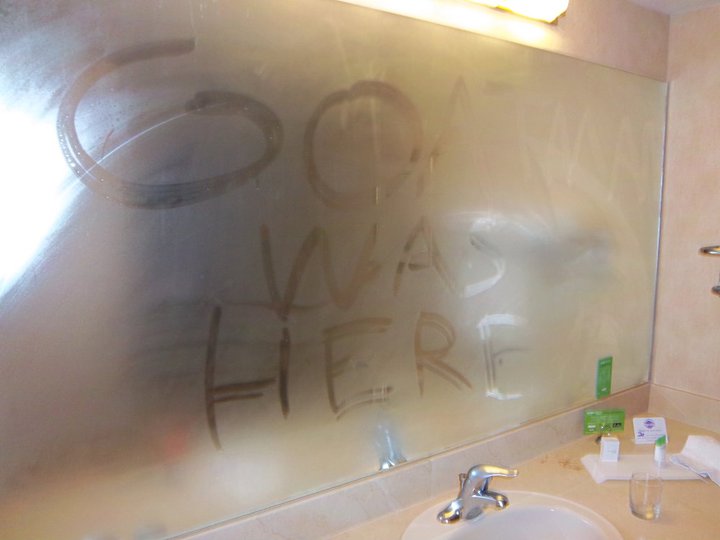
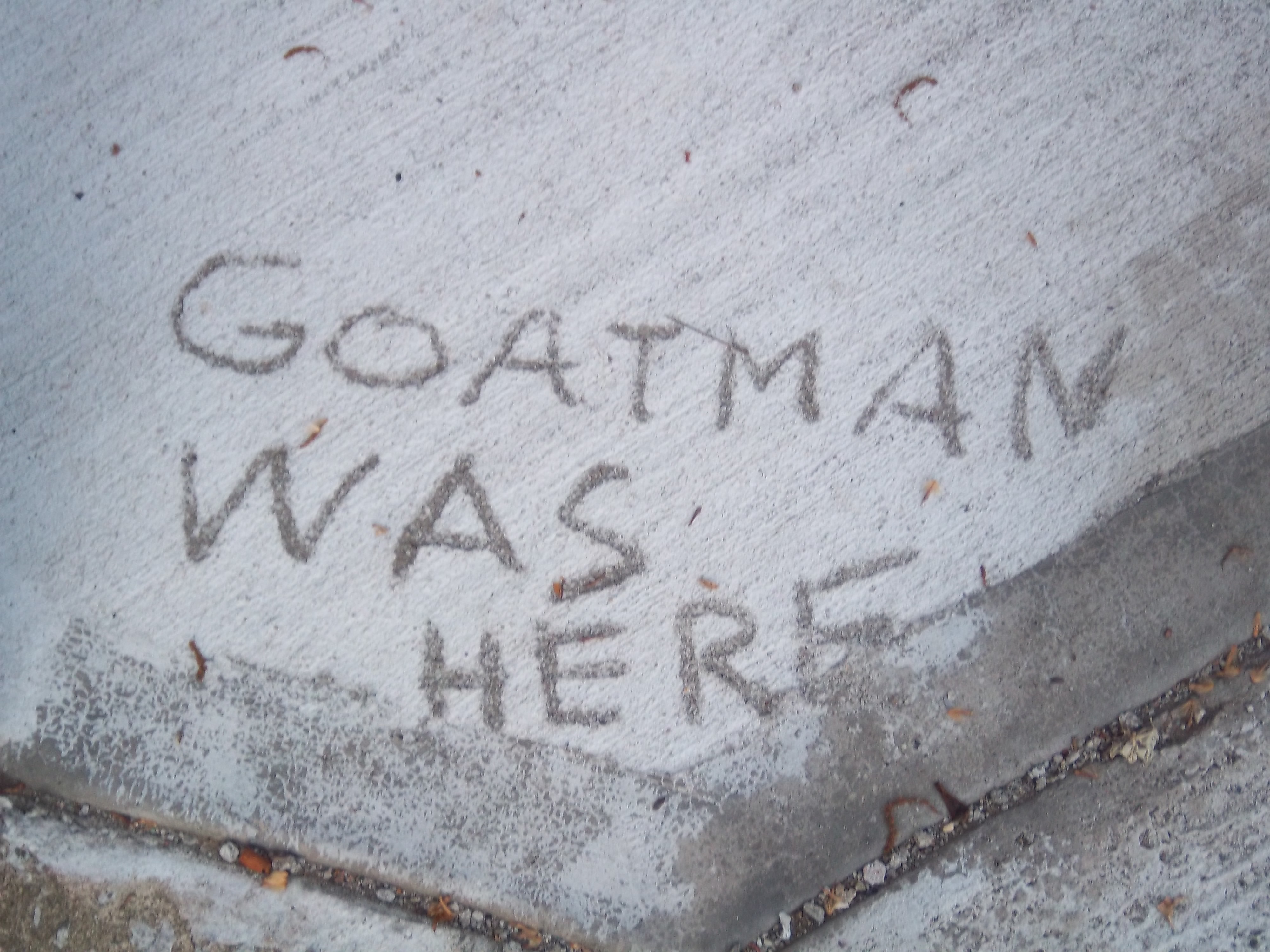
I’ve been meaning to post these photos for some time. Beginning with some travels last summer, I’ve been encountering these messages concerning someone called “Goatman.” A surname? A half-man, half-goat creature? I don’t know.

First came this one, in a hotel in Leesburg, Virginia (where I was stranded after missing my flight from Washington, DC to Munich.)Image

I thought I must have shaken him after making the next evening’s flight, but alas, nein. Below is his defiant message to me in a hotel room in Landshut, Germany. (The message reads “Goatman war hier.” Clever, Goatman, very clever. But if you were truly fluent in German you would have spelled it “Goatmann.”)

Image

I evaded Goatman on the next leg of my trip—Rome—but upon my return to the states, there he was, presenting me with this chilling reminder of his presence in a hotel room in Las Vegas.

ImageAfter getting back to my normal routine, and following many months of silence from the mysterious Goatman, there appeared one day in the freshly laid cement of my driveway a familiar, chilling message. Its subtext? This. Ain’t. Over.

Image

I’ve got a creeping suspicion I haven’t yet heard the last of Goatman, friends.

Another Great Writing Opportunity

Following up on this earlier post about a great (read: terrible) “ghostwriting” opportunity, here’s an ad I came across on Pittsburgh’s Craig’s List for fiction writing assistants.

As you’ll see, this sweet opportunity involves taking the ad-poster’s outline and . . . well, writing his/her novel, it appears. The successful candidate will have excellent grammatical skills, write quickly, and be able to make revisions quickly.

Okay, so it’s a ghostwriting gig. The person who posted this ad has an idea but isn’t good with words and just wants to pay someone to write it up. So let’s scroll down to the bottom where it mentions pay and see how much . . . Oh. Oh my. “Compensation: no pay.”

I won’t go on, because you probably get the picture. This crumb doesn’t mention anything about the successful applicant getting course credit, because he/she either doesn’t care or hasn’t thought that far ahead. What may be most audacious, though, is that applicants are asked to submit not only 1,000 words of writing but to spend additional time writing a 500-word statement asking for this person’s consideration. Does the poster think this is an attractive offer? Maybe he/she should mention literally any benefit the writing assistant(s) will derive from this arrangement.

My post about the ghostwriting gig was rather light-hearted, but this ad irked me so much I actually posted a response on CL. Was I too harsh? I don’t think so. It never fails to annoy me when I peruse CL or elance and see the rates people consider fair for writing (or editing or proofreading). I’m inclined to say that writing is not day labor, but that’s a faulty comparison because people have a better sense of the effort and skill involved in day labor. And I doubt you’d ever see someone get day laborers to build a patio or spread gravel around a driveway for no money by calling it an “internship.”

Update: Some time after I posted this, the person who posted the original, offending CL ad must have come to his/her senses (or, maybe, was adequately shamed by my response) and yanked the ad. So, you’ll have no luck following the link above. I imagine I’ve given a decent enough impression of the gist of the ad from the above takedown, however.

Lá Fhéile Pádraig Sona Daoibh

(That is, Happy St. Patrick’s Day!)

A pair of songs in honor of the day, both from The Pogues, one of my favorites. First, a nod to Irish folklore:

And next, an homage to the Irish immigrant experience (which I’d say St. Patrick’s Day is really about):

I find “Thousands Are Sailing” pretty powerful stuff. Particularly moving are the lines around the 4:28 mark: “Wherever we go, we celebrate / The land that makes us refugees / From fear of priests with empty plates / From guilt and weeping effigies.” It seems a nice summation of the Irish experience in leaving home for America.

Finally, name-checked in “Thousands Are Sailing” is the Irish writer Brendan Behan. (Pogues songs are fascinating to me in part because they are so densely referential; they could benefit from footnotes a lot of the time. Listen again to “The Sick Bed of Cuchulainn” and count all the names of people and places dropped in there. It’s staggering and adds a richness to the lyrics that more than offsets the occasional mystified feeling I get listening to the Pogues.) I’d thought Behan was an old-time Irish hero, a la Michael Collins or Wolfe Tone, but ah, not so. He’s a writer who wrote in English and Irish, and is the author, most famously, of Borstal Boy, a memoir.

I just started Borstal Boy yesterday, but man. It is already giving me chills. Here’s the opening:

Friday, in the evening, the landlady shouted up the stairs:

“Oh God, oh Jesus, oh Sacred Heart. Boy, there’s two gentlemen to see you.”

I knew by the screeches of her that these gentlemen were not calling to enquire after my health, or to know if I’d had a good trip. I grabbed my suitcase, containing Pot. Chlor, Sulph Ac, gelignite, detonators, electrical and ignition, and the rest of my Sinn Fein conjuror’s outfit, and carried it to the window. Then the gentlemen arrived.

Behan, 16, has just arrived in London with orders to carry out a terrorist bombing. He’s taken to prison, which is grim, and a lonely prospect for a 16-year-old:

As I stood, waiting over the lavatory, I heard a church bell peal in the frosty night, in some other part of the city. Cold and lonely it sounded, like the dreariest noise that ever defiled the ear of man. If you could call it a noise. It made misery mark time. (pg. 9)

Ah, there is nothing like Irish writing when it’s good. (On that point, see here.) I’m looking forward to the rest of the book more for the casual bits of poetic prose that are all but guaranteed, much more than the sure-to-be-dire story of Behan’s time in a “borstal”—an English reform school.

Anyway, Lá Fhéile Pádraig Sona Daoibh, everybody. Lá Fhéile Pádraig Sona Daoibh

A bold reimagining of ghostwriting

Two of the more fun freelance writing projects I’ve done have been ghostwriting gigs. One was a novel and one was a children’s book, and in both cases I really enjoyed talking to the author, figuring out what he/she wanted, and then sitting down and delivering the product.

Periodically, I’ll seek out more ghostwriting work by looking around Craig’s List, sometimes advertising my services there, or doing a search for “ghostwriter” on Indeed.com, a job-listing aggregator that has saved me time before. The stuff you find in these places is, however, not often worth finding. At least on Indeed, a lot of it comes by way of elance and oDesk, marketplaces where writers (and others offering services) bid on the jobs posted. Finding an appealing job listed there is always an exercise in deflation, because the person offering the job, either from an understanding of how the marketplace works or from simple cheapness, doesn’t offer much money; the situation is worsened by the bidders, who undercut one another and drive the price down. I suppose it’s classic economics, but it’s always a tough thing to see. Invariably I end up thinking about how many books I could read in the time it would take me to write someone’s non-fiction book and be paid $300 for my trouble.

This is all background to introduce an ad I stumbled upon today, one that truly stood out from the crowd. While the job-poster gets points for forthrightness, surveying what I know about ghostwriting I must say that this is a new one on me:

“I want to buy your completed manuscript/novel” reads the headline; “You will sign over the publishing rights and will not be credited in the book. Essentially, you will become a ghostwriter for it. Once a relationship is established this could lead to more work with much higher pay.”

Yikes. I guess that constitutes a ghostwriting relationship. Except for the part where I wrote this novel for myself, to hopefully publish under my own name. You know, as part of my hopes and dreams. But I guess I could sell it to you and have you publish it under your or someone else’s name . . . I mean, that would at least spare me the hassle of wrangling with publishers and agents, right? Really, what’s the harm—and I’m sure it’s a decent wage, right? . . . The average bid is how much? $1,527? (as of publication time)

To be honest, I was intrigued by this proposal because I thought of the first two novels I wrote. Neither one has seen the light of day; neither friend nor literary agent has seen these bad boys. I’m not proud enough to send them out into the world under my own name. Why not unload them on this guy?

Because he/she wants the first three chapters for consideration, but “. . . be prepared to send over the entire MS on short notice if you make it to the next round.” Also, he ends the post with “Good luck!” So now it’s a contest? Where the prize is peanuts to take my novel and publish it under your own name?

The crazy thing is, I’m still not at all sure I won’t be doing this. If you opt to do it, fellow writers, good luck!

New Fiction, Newish Book Review 2: On the Move

[Trivia question: What “classic” 80s movie had a sequel featuring the subtitle used in the title to this post? Answer at the end of the post. Hint, courtesy of the band Ween: “_________ was filmed at Woolworth’s / Boyz II Men still keeping up the beat.”]

I have a short story up at the Fourth River, a great literary magazine out of Chatham University that is now venturing into online territory. I’m very pleased to be part of that initial push, and to be published alongside Tina May Hall and Geeta Kothari. My story, “Woman in the Woods,” was written before I started graduate school and I worked on it most of the time that I was in grad school and a little beyond that, too. I submitted it for a (truly great and useful) exercise in Chuck Kinder’s fiction workshop wherein everyone submits a “crap story” at the outset of the class. No one is too put out to hear that their crap story is crap, and everyone’s defenses are lowered that much for the beginning of real workshopping. At the same time, the sometimes radical suggestions your classmates made for repairing the crap story were often brilliant, and of course you were desperate and detached enough to give them a try. At the end of the course you submitted a revision of the crap story; for me, at least, that draft was markedly improved.

“Woman in the Woods” is about the actor Bruce Campbell on the set of The Evil Dead, the classic 1981 horror film that launched the career of Campbell and of Sam Raimi, the director, Campbell’s childhood friend. Some particulars of the film’s plot are changed, and if you read the story you’ll see that it’s obviously fictional. But I tried to stay true to the sense of Campbell that I got from reading his autobiography If Chins Could Kill: Confessions of a B Movie Actor. In particular, there is one passage that inspired the story: during the filming of Evil Dead, staying in a remote cabin in Tennessee, Campbell got a telephone call from his father in the middle of the night, asking if he (Bruce) had seen his mother. It was the first realization Campbell had that his parents were splitting up. The book was otherwise such a good-natured schtick-fest, and Campbell on the page was so jokey and upbeat, that coming across that passage felt like a weird, lucid view through the cracks into something Campbell was keeping hidden, or that he’d forgotten as it receded further into his past. The choice to cash in favors and take out loans to shoot this low-budget horror film (and one, moreover, that was decidedly unorthodox in 1981, including elements of humor) represented a huge risk, and I could never quite buy Campbell’s depiction of the movie shoot as a long, relaxed hang-out session, albeit one that featured 16-hour days of getting fake blood dumped on him. I suppose I’m projecting now, and was projecting when I first wrote the story, but I guess “Woman in the Woods” is an interpretation of what my own internal state would have been had I been in the middle of nowhere, betting my future (at least to some extent) on this movie. I would have been, in a word, stressed.

Anyway, enough about that. I also have another book review up at Hot Metal Bridge. It’s of Ben Lerner’s Leaving the Atocha Station. I’m proud of the review because it’s the first one I’ve done for a book that I felt less than enthusiastic about, and I think I remained pretty fair-minded in writing about this novel. Leaving the Atocha Station is a decent book, and Ben Lerner is quite a writer. But he’s not a natural novelist, and it shows. However, the mix of textual and extratextual stuff going on with this book, which I at least skim in the review, is pretty interesting: Lerner is best known as a poet, and so a lot of the preoccupations of the novel are with writing poetry, its potential, ways to interpret it, what it gains and loses from appearing within the context of prose.

[Trivia answer here. If you’d like to hear the song lyric I alluded to above, and/or if you love Ween—and you really should—see here.]

New fiction, newish book review

Some new publications to add to the lists: I have a story, “Santo vs. Crushing Grief,” up at the Northville Review. It’s an “alphabet piece”; note the letter that begins the first word of the first sentence, of the second sentence, and so on, and you’ll see what I mean. Also, the story’s about Santo, of Mexican wrestling fame. Santo was a wrestler—a luchador, with one of those great silky masks that laces up in the back—who made the transition into starring in movies (just look at this amazing filmography!) in which he fought against werewolves, vampires, etc., as well as more prosaic villains like the Blue Demon (also a part of my story). I wrote it during my undergraduate studies and have always been really pleased with it, and I’m especially pleased the Northville Review, which I like a lot, took it.

Second, I wrote a review for Hot Metal Bridge of The Tiger’s Wife by Tea Obreht. That staggeringly, jealous-makingly great debut novel has been out for a while now, so you’re probably aware of it. But if you’d like to read my take, there it is. (I read The Tiger’s Wife while traveling in Germany and Italy this summer, and though the novel’s action is set a bit east of both places, it felt like a fortuitous turn of events; now, when I think of the novel, I think of a long bus ride from Rome to Florence as much as I do the novel’s striking images of a bombed city with exotic zoo animals running free among the wreckage.)