Adam Reger | Freelance Writer

Philadelphia-based freelance writer

Tag: Fiction

Further Franzen

Making steady progress through Freedom, which thus far is impressive and engrossing. The novel should be, and is, of special interest to me given the navel-gazing I’ve done in the past (see here and here for starters) on the subject of the mainstream novel, meant to garner millions of readers; implied in those dispatches was the notion that the literary novel belonged elsewhere. Franzen’s novel, of course, is a “literary” book that also aspires to bestseller status; Franzen has talked about his task of making the work so compelling one turns away from television and video games.

As a preface to registering a minor complaint about Freedom, let me say as clearly as possible that I greatly dislike this guy, B. R. Myers (at whom I took an earlier swipe here). He seems not to derive any pleasure from reading, only smug satisfaction from knocking down popular and approved-of books and writers. He has an unreasonable fixation on prose, too, to the seeming exclusion of all the myriad other elements that make a work of fiction go. And that is from someone who occasionally feels he is unreasonably fixated on prose style, who has wrestled with some of the same writers Myers trashes in his A Reader’s Manifesto—Don DeLillo, Cormac McCarthy among others—and in some instances tossed their books across the room.

With all that said, I start to wonder if Myers isn’t onto something, regarding Franzen’s prose, when I read sentences like this:

“She was a very good and painfully earnest and strenuously mature young person whose exasperation with Patty and Joey—her feckless mom, her ruthless brother—was seldom so extreme as not to seem comical” (171).

I hate this sentence because it is really quite masterful for about 3/4ths of its duration. Franzen uses rhythm to get away with out-and-out telling; nothing concrete here, nothing to be seen, heard, or felt. He keeps a beat even as he interrupts himself: feckless mom, ruthless brother. And in terms of telling us this, it all is perfectly satisfying and appropriate within the context of the story: this is a section where the main character, Patty Berglund, is sharing her autobiography; Franzen is using the fairly sophisticated trick of having a character write about herself in the third person, and having the “character” in that text (now at an extra remove or two from Franzen’s  third-person creation of the Patty Berglund character) reflect on the character’s daughter, Jessica, and what she thinks of her mother and brother. The sentence falls, too, within an immediate context of a couple stitched-together scenes involving Patty and the novel’s most interesting character, Richard Katz, a sexy musician and an old Berglund family friend.

All of which makes it mildly infuriating to come to the far side of that second em dash and have to stop flat. Wait. Seldom so extreme . . . not to be comical. So she’s rarely extreme, and it’s not funny. Or no, she’s seldom so extreme that it’s actually funny? This clause reads like a Mobius strip, and though the following sentences and a feel for the novel and the character, Jessica, tell me the meaning—she is so extreme it is funny (see how clear things can be when you strip away double negatives?)—by the time I decided to let it go, I’d come to a dead stop.

It’s just one sentence, and I’m sure by the time I hit page 562 of Freedom it’ll be long forgotten. But these are the kinds of lapses that, accumulating over the length of a book, can make it less readable, less engrossing, less magical than a book otherwise could be.
New MFA Week

I just updated my “Non-Fiction” page to include a cache of newly discovered blog posts over at Hot Metal Bridge, the online lit mag of the University of Pittsburgh’s MFA writing program.

In doing so, I re-discovered the fruit of one of my more inspired moments as an editor: “New MFA Week.” Being a mighty third-year at the end of the summer, I thought it would be cool to have various people contribute tips and advice to students who were at that moment finding apartments, registering for courses, and making travel arrangements to get to wherever they were starting their new lives as Masters students.

Some of the entries, like this dispatch on Pittsburgh’s vibrant food scene, are Pittsburgh-specific.

Other installments include how to go about locking down funding for your grad-school education; how to go about submitting your work to literary magazines; and some more general ruminations here and here (that one’s mine).

I feel most of the advice holds up, and should be of interest to non-Pitt soon-to-be-MFAs. (And the food stuff should certainly be of interest to non-MFA Pittsburgh people.) I wish we’d gotten to go a little more in depth, and there are people who I think could have contributed useful insights who I ended up not asking. But, you know: regrets, I’ve had a few / But then again, too few to mention, etc.

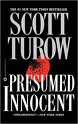
Presumed Innocent

As has been mentioned, I had a recent encounter that softened me up somewhat to considering “genre” and “mainstream” fiction with more generosity than I typically showed either. The first book I read afterwards was Stephen King’s Under the Dome (which was a great read; it’s proving not to linger on in memory but, you know, whatevs). But I also took the step of ordering a couple books that my conversational counterpart (the one-time Franklin W. Dixon, author of the Hardy Boys series) suggested as being particularly good “genre” fiction. (An aside, to be filed under Reasons I’m Glad to Be out of Graduate School: How nice merely to put “genre” in quotations and trust that my readers have a vague-but-close-enough sense of just what I mean, without needing to strictly define, problematize, historicize, put in a specific cultural context, or otherwise footnote the term.*)

One of these books was Scott Turow’s Presumed Innocent. I’ve been working on it for a few days and though it was slow going to begin with, I’m now one late night away from ripping through it. In this case, Franklin W. Dixon’s pitch to me is worth paraphrasing: to wit, that though people get them confused, Scott Turow is no John Grisham; his prose is respectable, shapely, precise; there is nuance, depth, and great intelligence. Since I honestly had conflated Grisham and Turow, and from years of seeing Presumed Innocent‘s gawdy blood-fingerprint on the paperback cover had lumped it in with the pulpiest of pulp novels, this was news to me and I snagged a copy of the book with some trepidation, but with high hopes as well.

All of which have been justified. The novel is thorough and deeply intelligent, in structure as well as in the ordinary details of each scene. (The plot, in a nutshell, is that a deputy district attorney is falsely accused of murdering a former lover, and must defend himself against the prosecution of a political rival. The set-up is an elegant way of allowing the narrator to move from the prosecutor’s table to the defendant’s seat, where he picks apart the strategies of both his defense attorney and the prosecution team. It may not sound like much, but I feel I can now understand why Law and Order re-runs are constantly playing: the law is fascinating, and an endless source of conflict and human drama. To be ushered through it like this is a real pleasure.)

I won’t say that much about the novel, which was a big deal almost 25 years ago—I fear I’d be embarrassing myself, like if I’d just discovered the Star Wars trilogy and couldn’t shut up about it. At some point I will have to process some further thoughts on so-called “genre” writing; I feel at the moment that reading Presumed Innocent is only deepening my earlier conclusions, namely that there’s nothing wrong with it.

In terms of my own writing as of this moment, reading these more mainstream books has increased my desire and willingness to “go for it” in the sense of making the story exciting, as well as in terms of using the oldest, sturdiest fictional tricks: surprises, secrets, unadorned conflict. It’s very much a continuing development, but it’s certainly a welcome on.

*Re-reading that aside, it seems not so surprising that I’d be contemplating a move away from canonical “literary” fiction and toward the stuff that’s sold in airport bookstores and consumed voraciously on beaches, Greyhounds, diners, etc. etc. I’ve always reacted nastily to the lit-crit side of things, whether it was during my undergraduate studies or while earning an MFA.

On Under the Dome; or, 1000+ words on literary versus genre fiction

I’m using that previous post to segue to a brief snapshot of where I am right now as a writer, by way of a long rumination on different modes of fiction.

About a week ago, I was at a party thrown by a Pitt creative writing professor. Invitations went out far and wide, and a lot of old students turned out. I ended up in a completely fascinating conversation with a guy who went through the program in the early nineties. For a few years during grad school and afterwards, he wrote under the pen name Franklin W. Dixon. If the name means anything to you, you may be freaking out now, as I was: Franklin W. Dixon is the author of the Hardy Boys series of novels.

Read the rest of this entry »