Adam Reger | Freelance Writer

Philadelphia-based freelance writer

Tag: Adam Reger

Two Self-Published Books of Fiction

It’s a little surreal to be writing this but I’ve gone ahead and self-published two books of my fiction through Amazon:

Half of Something is about 90 pages of “fun” fiction, some of my earlier published stories; and

Dr. Teen is a novel about an adolescent therapist restarting his life after a series of setbacks.

I posted Half of Something a few months ago and haven’t breathed a word of it to anyone. I’m very proud of it, but I’ve continued to send out my “serious” short story manuscript, which is all the things you’d find in the collections coming out from university press contests: sad and somber, thematically linked and rich, with interesting formal experimentation. (I think it’s more than that, of course—funny and weird—but so far only a few presses have agreed, slotting the collection onto their longlists or semifinal rounds.) The stories in Half of Something have (almost all) been published, but sadly a number of the online journals where these stories appeared have gone defunct; I was inspired to collect these stories when a friend asked for a recommendation of my favorite stories I’d written, and combing through the fiction page of my website I saw with horror how many links no longer went anywhere. Publishing this book is as much an act of archiving these pieces as it is an effort to make my name or any of the other goals we associate with publishing.

Dr. Teen is a different situation. I love this novel. My sweat and blood are in this book (I know, gross), but it’s not simply a matter of sunk costs. When I open this document, I still get swept up in the narrative, the scenes; I still think of images and incidents from this book.

I worked on Dr. Teen for years, and it would be true to say I wrote it twice. I wrote it first over the magical summer of 2015, when I’d been married a year and, after my first year as a college instructor, I had my first summer off in almost a decade. I made Dr. Teen by writing one episode each day of that summer, creating a lapidary portrait of the summer of my character, Errol Gropp, who’s trying to regroup and find a new direction in his life after a divorce and the loss of his counseling practice. Some days I’d write a thousand-word scene, and others I might feel pinched for time or uninspired, and write a scene of 100 words.

That summer I wrote Dr. Teen as more of a comedy—Errol was referred to consistently as “Dr. Teen,” as if mirroring how he saw himself, and the episodes were sillier. At some point years before this I’d written a short, incomplete story about a man sitting in an IHOP hectoring the DJs at a college radio station who’d declined to give him a summer program. The scene was based on both my own experience as a summer DJ at Beloit College’s WBCR and a hazy memory of working in the archives in the depths of Beloit’s library, organizing the WBCR files and coming across a prospectus for a call-in advice show aimed at teens. The man who’d proposed the show was a local and he’d been incredibly thorough in preparing this proposal for the consideration of the college students who always managed the station in the summer time: he included multiple suggested names for the show, I remember, as well as a list of equipment he would need. For years, the absurd boldness of these suggestions—I’ll just need a six-line phone system installed, thank you very much, and if you could hire an assistant producer to screen calls for me that would be terrific—stuck with me, and I knew the short story I’d written, really just a sketch, wasn’t sufficient to the rich sense of absurdity I had picked up on, and still remembered, from those materials in the archives.

Because the files contained a number of letters from the call-in DJ to the producers, taking them to task in increasingly strident terms for declining his show. Can you imagine, I asked myself, getting so worked up about something like a summer show on college radio? We didn’t use this word back then but the whole thing was so cringe. That first version of Dr. Teen steered into the cringe, into the overbearing and hilarious absurdity of a 48-year-old man making a federal case out of being passed over for one summer.

I took that version of Dr. Teen through the process of querying literary agents and then trying small presses and contests. I wondered what was wrong with this novel that no one had fallen in love with it the way I had, and so I went back to it. I got some wrongheaded advice from a well-meaning workshop I was in, and floundered around for a summer, but eventually found my way out of the wilderness. I rewrote Dr. Teen, this time in the same style that had meant so much to me—short episodes, each with its own punch and savor, in the style of the novels that had inspired me: Mrs. Bridge and Mr. Bridge by Evan S. Connell, and Abbott Awaits by Chris Bachelder. But this time I added pathos, a deep hurt lurking in Errol’s past that provides ballast for the considerable silliness and humor that are still present in the book. Why would a 48-year-old man be so upset about a silly radio show? What else is going on in his life that might explain it? This time, I found answers to those questions.

The perception of self-publishing has changed so much since I was in graduate school (which was, admittedly, a long time ago). Publishing itself has changed dramatically, not just since the end of grad school but since I first started querying agents re: that first version of Dr. Teen. I can’t deny that I feel some mixed emotions to be self-publishing this novel, but along with disappointment I also feel some disillusionment around the fantasy of publishing that I’ve had for a large part of my life. I’m over the idea that the book will have been a failure if it’s not published by a big house or a cool indie press.

When I was in elementary school and someone asked what I wanted to be when I grew up, I’d very often say, “An author.” It’s only with time that I’ve added all these additional qualifications, including not just the size and caliber of the press but the expectation that authorship would be my sole career. I don’t expect to make any money from either of these books but my hope is that I will publish future books and someone interested enough in my work will be able to find Dr. Teen and Half of Something and check out my back catalog.

Before this gets too maudlin I’ll just come to the point: I would be thrilled if anyone who may come across this blog post would check out either book. I’d love to hear what you think of them. That’s the point, in the end: to be read, to be out there in the world. Better to send Dr. Teen out there, whatever happens, than to let this beloved book sit unread in a folder on my hard drive (or, you know, up there in the ether, as the case may be).

New Fiction at Storyscape Journal

Cleveland_City_Free_Stamp_-_panoramio.jpg

I’m pleased and excited to link to a story, “Awful Magic,” in the just-released issue of Storyscape Journal, which I’ve read and liked for a while now.

The story is about grief, magic, and belief, among other things, and is set in one of my favorite places: Cleveland!

I’m still digging through this issue but there is some great stuff in it. Working with the editor, Alyssa Songsiridej, was a pleasure.

Looking through proofs for this issue gave me a chance to think about how many different versions this story went through before it found its way to publication. Let’s just say a lot. Glancing through my files, the version I submitted was either the 19th or 20th draft of this story.

What most struck me, reading through this version, was how much more I had written about various characters and ended up cutting. Example: one of the main characters, Brian, is a struggling magician who turns to “comedy magic” when he learns that he has better luck making people laugh than he does wowing them with his magic. Brian learns that a video exists of him from his days as a “serious” magician, working under the name The Great Tostini.

All that made the final cut of the story, but I cut out the origin of the name: he had a job working at supermarkets around the Cleveland area, doing in-store promotions and handing out free samples for various products, one of which was a line of tostinis. Brian is so taken by this name, feeling that it sounds vaguely exotic and mysterious, that he adopts it as his stage name.

Going through proofs, I was pleased that I’d taken out that detail—it really does nothing for the story and doesn’t give valuable new information on Brian. But I also felt like it really fit, and remained true even if it wasn’t something I told readers. I’m hoping the name The Great Tostini suggests some kind of story.

This is something I often tell fiction students, that frequently sounds artsy fartsy or almost cultish: knowing more about your story and your characters than you let on, cutting things out of a story, can have a surprisingly powerful effect. Part of this advice comes from the writerly truism that you can omit information from a story, but as the writer you should know what’s not there. Part is a more nebulous sense that the cut material leaves behind a kind of residue that sensitive readers will pick up on; or perhaps it’s more accurate to say that readers can detect a kind of negative space where that information was, and know that an answer exists, that there is more to the picture even if they can’t tell what it is.

Anyway, that’s my perspective on this story, and hopefully not the most interesting or compelling thing for other readers. Definitely check out this really excellent journal. The thing that attracted me to Storyscape in the first place is the way they curate the journal, not using “fiction” and “non-fiction” as categories but “truth,” “untruth,” and “we don’t know and they won’t tell us,” where neither editor nor writer helps you out by declaring what’s true or not true. This last category is so much up my alley as a fiction writer and a thinker about fiction, it’s kind of funny to me that my story is squarely in the “untruth” category: it kind of feels like everything else I’ve been writing for the last couple years should be in that “we don’t know” box.

Ghostwriting: How does it work?

Ghostwriter 2This is the second installment of a brief series of blog posts relating to ghostwriting. In the first installment, I looked at some common misconceptions about ghostwriting.

In today’s post, I want to dive deeper into a question that can be a bit of a sticking point for many people who are thinking of hiring a ghostwriter.

“How does it work?”

Once you’ve found a ghostwriter and you’re ready to get started . . . well, how do you get started?

There are three main ways that a ghostwriter works with his or her clients. In my experience, writing a book for a client is typically a mix of these three methods, and very rarely is just a single method employed.

Read the rest of this entry »

The Great Pittsburgh Spelling Bee of 2014

photo (11)

This weekend I had the good fortune of participating in the Great Pittsburgh Spelling Bee of 2014, which raised funds for the extremely worthy Literary Arts Boom (LAB), a project run out of an awesome Pittsburgh nonprofit, Assemble. LAB is Pittsburgh’s answer to the 826 writing centers project from McSweeney’s and fills the same niche of tutoring kids in writing, publishing, making reading and writing fun, and so on.

A friend texted my fiancée and I about the spelling bee and, without too much reflection, I signed us both up.

I should say that I have a history with spelling bees. I participated in my middle-school spelling bee every year I was eligible (sixth, seventh, and eighth grades). I still remember each word that knocked me out: “raunchy” in sixth grade (“rawnchy”); “dormitory” in seventh (“dormitary”) . . . and the last one I’ll mention in a moment.

I love spelling bees; I love spelling. I always thought I was great at it in school, and I entered the spelling bee last Saturday feeling like I’d only gotten better over the ensuing years. Since eighth grade, I’ve graduated high school and college and earned a Masters degree in writing, and have accrued about a decade of experience as a professional proofreader, copyeditor, and writer.

Still, I didn’t have any expectations. I basically took it on faith that somewhere in Pittsburgh there existed a medieval Latin-reading philosophy grad student, or a wizened old doctor who knew all the derivations of a thousand polysyllabic conditions and syndromes, or an insomniac librarian with a photographic memory, who would show up and dominate the field with the detached cool and confidence of a spelling assassin.

Read the rest of this entry »

So This Is What That Feels Like

My last name, Reger*, is not the most common in the world. If you go looking for famous people, about the only one out there is Max Reger, a German composer and pianist of the late 19th century and early 20th. (Max was also the name given to my parents’ German shepherd.)

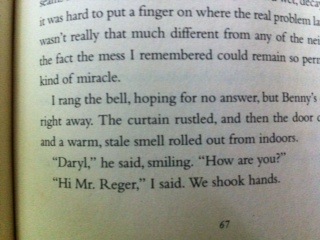
So it was entirely novel, reading the story “Bennie” in Jon Raymond’s really excellent story collection Livabilityto see this:

Image(Look in the bottom left.)

I was floored. I showed it around to my family, and watched each one of them have the same reaction: Reading, reading, reading, then suddenly a start, a raising of the eyebrows, looking up and acknowledging that yes, that was actually worth their time.

It had literally never happened to me before, as a reader. I doubt I’ve ever even been reading something and seen Max Reger’s name come up. (He’s not that famous, and I don’t read about classical music basically ever.) Other people must see their names every once in a while, and have probably become slightly more accustomed to the faint shock of it. The rarity of seeing “Reger” out there has never been something I’ve regretted, but it was kind of cool for my name’s sudden appearance to give me such a thrill.

*In case anyone is even remotely interested, the way my family (and, I believe, Max Reger) pronounces my last name rhymes with “kegger” or “beggar” (neither of which makes for the most useful or flattering mnemonic to share with new acquaintances). Not—I repeat, NOT—Ree-ger as in “eager,” “meager,” “big-leaguer,” or anything else that rhymes with “Ree-ger,” a pronunciation that haunted my childhood and that still kind of grates on me.

This ‘n that

Updates to several recent posts:

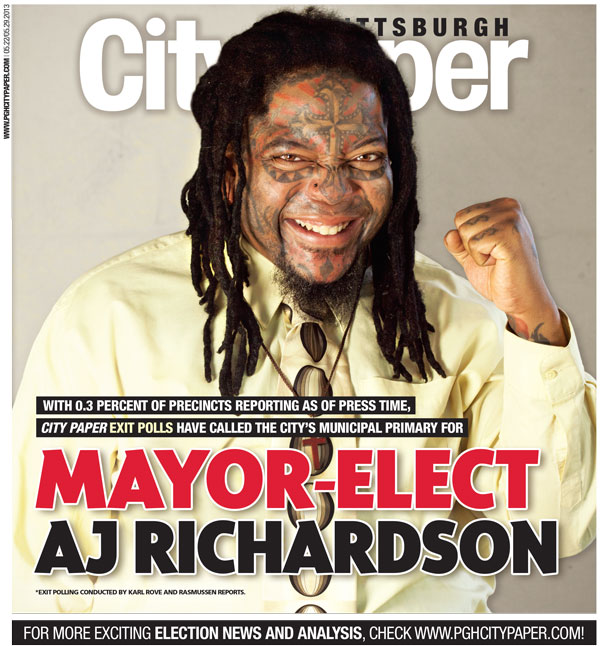
-I wrote about the fascinating case of A.J. Richardson, the candidate for the Democratic nomination for mayor of Pittsburgh whose face is covered in tattoos. Others did not find him quite so fascinating, as he came in dead last in Tuesday’s primary election, with a vote total described, variously, as “in the triple digits” and “a smattering.” (Yikes. I’m no politics wonk, but I know you’ve got to get more than a smattering of votes.)

Some interesting links on Richardson:

*A Pittsburgh City Paper (blog) interview with him after the election.

*A City Paper blog photo of Richardson with his tattoos “removed.”

*And here’s the City Paper‘s cover for this week:

Image


-Following this post, about my struggles with plantar fasciitis: this week, I got a cortisone shot in my heel to hopefully get me over the hump by reducing inflammation in my plantar fascia. As mentioned in the prior post, I really did not want to get a shot, let alone have surgery, but over time that opposition eroded enough that I basically asked for the shot.

So far my foot has felt better. The reduced inflammation has allowed the stretching to be more effective (I think), and I’ve done some increased activity. Nothing major: standing up while doing some weightlifting. I’ve been tempted to run over the weekend, but I think I need to hold off.

-And finally, I went ahead and secured the domain name adamjreger.com. adamreger.com, unfortunately, is taken by another Adam Reger who has had the domain since at least 1998; I had the bad luck to have the same name as an internet-savvy tech guy.

As far as I can tell the new domain name has meant no changes to anything or anyone, and hardly seems worth mentioning except that it feels like a step toward greater permanence.

Free Box #5: Old Testament Beard, Where Have You Been All My Life?

“Old Testament Beard, Where Have You Been All My Life?” is the title of my undergraduate thesis in creative writing. I’m alarmed to find it’s more than 10 years old.

It was doing absolutely nothing, hanging out in a filing cabinet, so since I have a scanner and a website, I thought I’d post it. It’s quite a bit of writing, especially for an undergrad: 60 pages comprising two stories, three poems, one essay, and a tough-to-define thing that I guess you could call a story. (It’s text that was screen-printed onto a t-shirt as part of a group art project; see the very last page of the document and decide for yourself.) I’ve improved as a writer since then, certainly, but I remain fairly proud of a lot of this writing

Anyway, here’s Old Testament Beard Where Have You Been All My Life?.


Free Box, Installment #2: Novel Appendix

Part of what I want to use this feature, Free Box, for is to post old stuff that’s moldering in my filing cabinets and on various disks and computer drives, that will never be published and would be more fun to share now than when someone is going through my papers after my death. (Free Box #1, with an explanation, is here.)

To that end, here’s a blog entry that I posted about two years ago. Here’s the piece of writing I’m putting in the free box (with a warning that there is some strong language and content in this piece). The blog entry gives fuller context, although I’m not sure anything could properly explain where this came from, in the sense of what I was thinking at the time.

Sentences from News Story on Boston Marathon Bombing Suspects Rendered as Prose Poetry

From several of the more prosaic sentences in this Wall Street Journal piece about the two suspects in the Boston Marathon bombing, I’ve constructed what’s either a prose poem or a piece of flash fiction. Here it is:

“A Look at the Brothers”

By Alison Fox, Sara Germano, Siobhan Gorman, Evan Perez, and Adam Reger

On the table in front of the two young men is a chicken dinner, ranch dressing and a jug of orange juice in a room that resembles a dorm kitchen.

Others started sending him “photographic gifts” on the site that included police cars, sticks of dynamite and, in one case, a brick.

The date of the photos wasn’t clear.

Attempts to reach the photographer were unsuccessful.

A second uncle also lives in the area.

There are quite a few auto-body shops.

Have a great weekend, everybody!

Morning Fog

It is a foggy morning in Pittsburgh. As is always the case when fog is general across the city, I am reminded of one of my favorite short stories, Tobias Wolff’s “Our Story Begins.” The story’s setting is San Francisco, and the fog is a bit more aggressive than it is here this morning, but what lovely descriptions:

“The fog blew in early again. This was the tenth straight day of it. The waiters and waitresses gathered along the window to watch, and Charlie pushed his cart across the dining room so that he could watch with them as he filled the water glasses. Boats were beating in ahead of the fog, which loomed behind them like a tall, rolling breaker. Gulls glided from the sky to the pylons along the wharf, where they shook out their feathers and rocked from side to side and glared at the tourists passing by.

“The fog covered the stanchions of the bridge. The bridge appeared to be floating free as the fog billowed into the harbor and began to overtake the boats. One by one they were swallowed up in it.”

. . .

“Charlie started home the long way, up Columbus Avenue, because Columbus Avenue had the brightest streetlights. But in this fog the lights were only a presence, a milky blotch here and there in the vapor above. Charlie walked slowly and kept to the walls. He met no one on his way; but once, as he paused to wipe the dampness from his face, he heard strange ticking steps behind him and turned to see a three-legged dog appear out of the mist. It moved past in a series of lurches and was gone. ‘Christ,’ Charlie said. Then he laughed to himself, but the sound was unconvincing and he decided to get off the street for a while.”

Copying out these passages, I was struck first that these aren’t actually flamboyantly beautiful descriptions of fog; second, that they’re sneakier and more effective than that, because what they conjure up is the sensation you get when you’re trapped or enveloped in fog: in the first two paragraphs, Wolff describes a bus boy inside a tourist-trap restaurant as the fog closes in, strangling business for the evening; in the last, the bus boy walks home alone, late, through the fog and the empty streets. The three-legged dog is not Wolff’s usual thing—he’s a more realistic, generally unsentimental writer, not given to quirks or humor other than the dry sort—but here it makes sense: strange things come out of the fog, and everything looks a bit stranger when its context is wiped away. You can read metaphorical significance into the fog, isolating the main character, Charlie, forcing him to confront his own life—but you don’t really need to; it’s fog, it’s San Francisco.

I can remember reading “Our Story Begins” for the first time and getting chills. It was the summer and I was sitting in a laundromat in Philadelphia, waiting for my load of wash to be done. Walking around the city I had picked up a book called Graywolf Annual for some year, maybe 1989 or ’90, in a box of books put out on the curb with a placard reading “Free Books!” There were a number of fantastic stories in that collection—Andre Dubus and Richard Ford were represented, along with Annie Proulx’s “The Half-Skinned Steer”—but “Our Story Begins” was the one that made me put the book down, look around, and feel obscurely that I had been taught something important and at just the right time. I was older than the main character—23 or 24 at that time—but in not so different a place in terms of life and career. In the story, Charlie is revealed to be an aspiring writer who has moved to San Francisco with thoughts of Kerouac, of Allen Ginsberg or Gregory Corso popping into the cafe where he goes to escape the fog; his novel, we’re told, has been returned without comment by all the publishers he’s sent it to—except for one, who’s written “Are you kidding?” across the title page. Without encouragement, friendless, with San Francisco’s long, cold summer wearing him down, Charlie is just on the point of giving up. His encounter in the cafe, listening in on an ambiguous conversation between a married couple and the choir director the wife is having an affair with, sustains Charlie, convincing him to push on a little further by conveying a sense of possibility, of wonder at what the world will turn up next. It was an immensely encouraging idea to read in a story; whether or not any of this happened to Tobias Wolff, it seemed impossible he hadn’t lived some version of this pivotal moment, deciding whether to go on.

I’ve already sort of spoiled the story for you, but below the jump is its conclusion—a big part of why I’ve remembered this story so fondly for so long: Read the rest of this entry »