Adam Reger | Freelance Writer

Philadelphia-based freelance writer

Category: Writing

Jack Pendarvis & John Brandon Podcast

One of my most favoritest of contemporary writers, Jack Pendarvis, reads here at an Oxford, MS bookstore with the writer John Brandon (who seems poised for big success with his second novel, Citrus County, from McSweeney’s). I liked, but did not love, Brandon’s first novel, Arkansas, also from McSweeney’s. (A compendium of info on that book is here. They published a couple excerpts, but I’m unable to locate those on the website.) However, I loved, not liked, Brandon’s prose, so I may well check out Citrus County.

Jack Pendarvis cracks me up, whether I’m reading his “blog” or one of his story collections (Your Body Is Changing and The Mysterious Secret of the Valuable Treasure), or his novel, Awesome. (One of my great accomplishments during graduate school was, while fiction editor of the grad-student lit mag, Hot Metal Bridge, to solicit a selection from Awesome. Mr. Pendarvis was gracious enough to give us an excellent section of the book, and was a pretty darn nice guy to correspond with.) He is pretty funny here, reading from a column he writes for The Believer. It kind of bummed me out to hear him slated as the opening act, but I guess what with John Brandon’s being something of a rising star, that status may now be appropriate.

The Brandon reading is pretty excellent, too. After hearing what Citrus County is about—it seems to involve a terrible crime, and potentially a love triangle—I am all the more intrigued after listening to this excerpt, which features a middle-school teacher running his students through genealogy presentations and reluctantly planning for his tenure as coach of the school’s girls’ basketball team. If you’re like me, you love it when random stuff comes together.

One sour note about the podcast, as I experienced it: the player really, really sucks. And by that I mean it won’t let you pause or fast-forward (which would be a convenience if you tried to pause the broadcast, realized pushing Play took you all the way back to the beginning, and thought you’d like to skip over the ten minutes you’d already heard).

On “Inception”

I saw it yesterday and am still thinking it through. If I don’t love a movie immediately, or have very high expectations for it that are not met, I sometimes over-correct and say that the movie was bad or that I disliked it. I can admit that Inception wasn’t bad, and that on the whole I liked it. But it felt like something was missing, or like the overall set-up was overly intellectual and failed to communicate any real feeling.

This review, by Christopher Orr over at The Atlantic, comes pretty close to my own feelings on Inception. I certainly don’t care for Orr’s (mild) diss of The Prestige, though.

I now turn my sights to the technically virtuosic, exquisitely conceived and designed latest film from a director whose work I typically love that I’ve really been looking forward to this summer: Micmacs. I’d take Jean-Pierre Jeunet over Christopher Nolan any day.

Reason #2 to Love Pittsburgh: Gist Street Reading Series

(As mentioned here, I’m enumerating reasons in random order, but giving them consecutive numbers (as opposed to “Reason #6,387 to Love Pittsburgh”).)

Pittsburgh definitely punches above its weight class when it comes to the literary scene. A lot of that is due to the universities: the deep-pocketed Carnegie Mellon University brings in some jaw-dropping readers every year, and the University of Pittsburgh and Chatham University (nee College) both have MFA programs that both bring in and incubate talented writers.

But it’s sort of de rigeur for universities to pull the weight. The really impressive thing about the city’s literary community is the Gist Street Reading Series. Independent of the universities, and with only a tiny bit of funding from the Pennsylvania Arts Council, Gist Street is a local, homegrown phenomenon. The set-up’s simple: the first Friday of the month, two writers—one fiction, one poetry—read from their work in a loft space in Pittsburgh’s Uptown neighborhood (a tiny, isolated, somewhat sketchy neighborhood just on the cusp of Downtown). It’s BYOB—and B.Y.O. Food, Dessert, Anything You Want to Eat or (Preferably) Share with a Bunch of Strangers. As the Series’ slogan goes, “It’s not about suffering.” And it’s not: there’s always ample eating, drinking, and conversation.

And, remarkably, it’s always, always filled to capacity. Stories abound of people getting to the space twenty minutes before the slated start time to find a sign taped to the door: “We’re Full. Sorry.” I’ve been shut out forty minutes before the reading was supposed to begin.

Tonight I got there well ahead of time. It was the annual cookout, done in tandem with a small press of note. Last year it was McSweeney’s. This year it was Michigan-based Dzanc Books. The full line-up of readers is here. All were excellent; for my money, Jeff Parker’s selection from “False Cognates” stood out, but its being funny and straightforward probably helped. As much a part of the experience, however, was the food. It was a feast. Pittsburghers can cook, or at least Gist Street loyalists can. Many, many delicious items were eaten, by me, tonight.

But I am sort of beating around the bush. I must admit a deep bias I have in favor of Gist Street. It involves the raffle they hold at each reading.

Upon entering, each person writes his or her name on a slip of paper and tosses it in a basket. At the end of the reading, names are drawn for a variety of prizes. Each reader puts up a copy of his/her book. There is locally grown produce. Sometimes someone will offer a homemade ceramic piece, or a hand-knit scarf (which a friend won once).

Tonight, I won a most excellent prize: a medley of vegetables from the garden of Sherrie Flick, one of the Series’ founders and organizers (and also a published novelist and flash-fiction writer (what a combination!)). (In the box: a cup of blackberries; two carrots; two radishes; a zucchini; green onions; two plums; a tomato; and a small pepper-ish sort of thing.) Of even further note, though, is that this marked the third time I’ve won something in Gist Street’s raffle. (I won a galley copy of Cathy Day’s The Circus in Winter, and a copy of Dean Young’s Primitive Mentor (which is sort of a raffle within a raffle, for me, because I am utterly stymied by most poetry and Dean Young is on the very short list of poets whose work tends to make sense and please me more than it baffles and irritates me).) It’s to the point, now, where I expect to win something when I go, and am kind of miffed and incredulous when I don’t.

Anyway, consider this a full-throated, whole-hearted recommendation of the Gist Street Reading Series. Even subtracting out the great prizes I’ve won over the years, it’s a great experience and a definite credit to Pittsburgh’s literary community.

Note to Self re: Research

When conducting research on, say, old-timey pirates, make sure that any films you may select off of Netflix are not actually porno flicks edited down to get an R rating.

Yes, friends, I unwittingly popped in a softcore porno, notebook poised to jot down any good period details that I might use in the project I’m working on. I swear that when I picked this movie (Pirates—the nondescript title probably contributed to my error) I had a hazy memory of its appearing in theaters a year or two ago. (Why did I picture Geoffrey Rush in pirate garb?)

This movie is very, very good for an adult film—terrible acting, as you’d expect, but excellent costumes and cheesy-but-still-impressive digital effects. But . . . how to say this delicately . . . something is definitely missing.

Lyrics of Suzanne Vega’s “Tom’s Diner,” Reformatted as Flash Fiction

I am sitting in the morning at the diner on the corner. I am waiting at the counter for the man to pour the coffee.

And he fills it only halfway. And before I even argue he is looking out the window at somebody coming in.

“It is always nice to see you,” says the man behind the counter to the woman who has come in. She is shaking her umbrella.

And I look the other way as they are kissing their hellos.

I’m pretending not to see them. Instead I pour the milk.

I open up the paper. There’s a story of an actor who had died while he was drinking. It was no one I had heard of.

And I’m turning to the horoscope and looking for the funnies when I’m feeling someone watching me and so I raise my head. There’s a woman on the outside looking inside. Does she see me?

No, she does not really see me because she sees her own reflection. And I’m trying not to notice that she’s hitching up her skirt. And while she’s straightening her stockings her hair has gotten wet.

Oh, this rain it will continue through the morning. As I’m listening to the bells of the cathedral I am thinking of your voice…

And of the midnight picnic once upon a time before the rain began…

I finish up my coffee. It’s time to catch the train.

This is Dumb

But this site says I write like J.K. Rowling, based on their analysis of five or six paragraphs of a short story I had lying around. This Entertainment Weekly blog post summarizes why this is dumb. I don’t know what I expected. Anyway, further evidence that genre writing is where I’m headed.

On Economics

What I know about economics is pretty conventional, and what I have to say is pretty uninformative. My general take is that it’s a fascinating and wide-ranging discipline, capable of analyzing and explaining nearly everything, but that the interest of any particular scholarly article is invariably ruined by the appearance of math. (If you are asking why I would be looking at scholarly economics articles in the first place, rather than sticking with Freakonomics or occasionally perusing Slate: it’s because I work on a scholarly economics journal. I have to look at these things.)

I am only just catching on to the preponderance of economics-for-laymen resources that are out there. In that vein, I’d like to share an economics blog I’ve found super interesting: Dan Ariely’s. He’s a behavioral economist at Duke. Behavioral economics (again, to the extent that I understand anything) is much more focused on the applicability of economics to life, and to that end uses the observed behavior of human beings much more than classic economics. A pleasure of coming across work in behavioral economics, often, is simply noting the topics that these scholars have gotten interested enough in to pursue (and to pursue so doggedly: we’re talking, often, of long-term, labor-intensive studies looking at reams of data, if not pestering thousands of people for survey responses. It’s the kind of thing that, as a creative writer, kind of boggles my mind.). At Ariely’s blog right now he’s discussing happiness, personal efficiency, and the reasons you might let your vegetables go to waste in your refrigerator drawer. And I looked into him after being pretty impressed by this video, which follows a recent paper Ariely published on online dating.

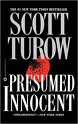
Presumed Innocent

As has been mentioned, I had a recent encounter that softened me up somewhat to considering “genre” and “mainstream” fiction with more generosity than I typically showed either. The first book I read afterwards was Stephen King’s Under the Dome (which was a great read; it’s proving not to linger on in memory but, you know, whatevs). But I also took the step of ordering a couple books that my conversational counterpart (the one-time Franklin W. Dixon, author of the Hardy Boys series) suggested as being particularly good “genre” fiction. (An aside, to be filed under Reasons I’m Glad to Be out of Graduate School: How nice merely to put “genre” in quotations and trust that my readers have a vague-but-close-enough sense of just what I mean, without needing to strictly define, problematize, historicize, put in a specific cultural context, or otherwise footnote the term.*)

One of these books was Scott Turow’s Presumed Innocent. I’ve been working on it for a few days and though it was slow going to begin with, I’m now one late night away from ripping through it. In this case, Franklin W. Dixon’s pitch to me is worth paraphrasing: to wit, that though people get them confused, Scott Turow is no John Grisham; his prose is respectable, shapely, precise; there is nuance, depth, and great intelligence. Since I honestly had conflated Grisham and Turow, and from years of seeing Presumed Innocent‘s gawdy blood-fingerprint on the paperback cover had lumped it in with the pulpiest of pulp novels, this was news to me and I snagged a copy of the book with some trepidation, but with high hopes as well.

All of which have been justified. The novel is thorough and deeply intelligent, in structure as well as in the ordinary details of each scene. (The plot, in a nutshell, is that a deputy district attorney is falsely accused of murdering a former lover, and must defend himself against the prosecution of a political rival. The set-up is an elegant way of allowing the narrator to move from the prosecutor’s table to the defendant’s seat, where he picks apart the strategies of both his defense attorney and the prosecution team. It may not sound like much, but I feel I can now understand why Law and Order re-runs are constantly playing: the law is fascinating, and an endless source of conflict and human drama. To be ushered through it like this is a real pleasure.)

I won’t say that much about the novel, which was a big deal almost 25 years ago—I fear I’d be embarrassing myself, like if I’d just discovered the Star Wars trilogy and couldn’t shut up about it. At some point I will have to process some further thoughts on so-called “genre” writing; I feel at the moment that reading Presumed Innocent is only deepening my earlier conclusions, namely that there’s nothing wrong with it.

In terms of my own writing as of this moment, reading these more mainstream books has increased my desire and willingness to “go for it” in the sense of making the story exciting, as well as in terms of using the oldest, sturdiest fictional tricks: surprises, secrets, unadorned conflict. It’s very much a continuing development, but it’s certainly a welcome on.

*Re-reading that aside, it seems not so surprising that I’d be contemplating a move away from canonical “literary” fiction and toward the stuff that’s sold in airport bookstores and consumed voraciously on beaches, Greyhounds, diners, etc. etc. I’ve always reacted nastily to the lit-crit side of things, whether it was during my undergraduate studies or while earning an MFA.

The Great Staycation of 2010 + The Saturday Problem

I’ve cleverly taken Friday off from work, giving me a four-day weekend. I’ve been salivating over it all week, as I was recovering from one of those weekends where you don’t really get a moment’s rest, and walk into work thinking something like “Really? Already?”

And now. My staycation. Is. Here.

I’ve generally been dubious about the notion of a “staycation” (or, for that matter, any of this kind of neologism you’re apt to read about in the New York Times Style page or wherever). It sounds like a lazy vacation, or a vacation for unimaginative people. But if you’re stressed, and just want to chill out for a few days, the idea of chilling around the house can be really, really appealing. Especially as compared with thoughts of getting to the airport, going through security, renting a car, checking into a hotel, etc. etc.

So far I’ve done nothing special—I ran, ate well, ran some errands, and have been watching both World Cup matches. (Yeah, Netherlands! And Go, Ghana!) And it has been great.

But, as often happens on lazy weekends, there’s an obligation hanging over my head. And its name is writing. I haven’t done any today. I call this the Saturday problem; it’s the problem of having, seemingly, all day to take care of the task of writing, leading one to put it off and put it off until there’s a half hour left until you’re due to go out for dinner, or it’s 11:30 p.m., or you’re about to sit down to it when a friend calls to see if you want to come out for a drink.

I’d imagine this is a common problem for writers. It seems like just another species of the procrastination problem, that cliche about writers having very clean houses because there’s always some suddenly-pressing task to be done before he/she really sits down to do it. I don’t know that I have any readers yet, but I invite any of them to chime in on this matter.

For whatever it’s worth, I do plan to get down to it as soon as the Uruguay-Ghana game ends. For real, y’all. In this instance, I’m inspired by not having completely limitless time: I’ll be going later to see the most recent film from M. Night Shyamalan, The Last Airbender. Not because I’m particularly excited about it; I haven’t seen one of his films in the theater since Signs, which I thought was pretty absurd. I also recently saw Unbreakable, which various people had talked up, and which I also thought was preposterous. And if I had limitless time and no obligations, I might take the trouble to see The Happening, which from various YouTube clips I’ve seen seems pretty amazing.

No, I’m not going for the aesthetic edification of it. (See the paragraph below.) I’m going because I am proud to bursting that my own flesh and blood, my younger brother, was a production assistant on the film and for the first time in his career I’ll be able to sit rapt through the credits, as his name will appear somewhere in there. (The premiere was this week and I got a late-night photo texted to me, a blurry screen shot of the credit scroll.)

Sadly, though, the film appears to be terrible. (Here’s a withering review from my go-to source for media reviews, The AV Club.) But on the plus side, I’ll be seeing it at a drive-in movie theater. Check it out: the theater’s website is a masterpiece of clip art. In any case, if the movie is terrible I’m hoping the novelty of the setting will help me pass the time until the part I want to see (the end credits) comes up.

Weirdly Appropriate Extract from Under the Dome

I said I probably wouldn’t write more about Stephen King’s Under the Dome, but I just came across this snippet, which seems bizarrely germane to the literary-vs.-“genre” fiction stuff I was going on about earlier. The background is that this elderly English professor and his grad student love interest have been trapped in Chester’s Mill when the Dome falls, and subsequently roughed up by the local cops:

“. . . At the double doors, Thurston Marshall looked back. A shaft of hazy sun from one of the high windows struck across his face, making him look older than he was. . . . ‘I edited the current issue of Ploughshares,’ he said. His voice quivered with indignation and sorrow. ‘That is a very good literary magazine, one of the best in the country. They had no right to punch me in the stomach, or laugh at me.'”