Adam Reger | Freelance Writer

Philadelphia-based freelance writer

Category: Pittsburgh Copywriter

Ghostwriting: Questions Before You Get Started

Ghost Image

This is the third installment in a series of blog entries about ghostwriting. I’m attempting to provide practical information for those who may be considering hiring a ghostwriter. The series started with some misconceptions about ghostwriting and continued with a rundown of the different ways you might work with a ghostwriter.

Today I want to cover how to prepare to work with a ghostwriter. I sort of covered this in my last post, on the different ways a ghostwriter might work—it was certainly my hope that looking through that list of methods might spark some readers to say, “Yes, that is definitely how I’d prefer to work with someone.” Figuring that out is a big part of the battle.

But mostly I want to move beyond the question of how you’ll get the ghostwriter the information they need to think about ways to identify what’s important to you and get at least a general picture of your book that you can communicate to the ghostwriter. Below is a list of questions and concerns to think about before you reach out to a ghostwriter. If you have even the beginnings of ideas on these topics, your ghostwriter will definitely appreciate it.

Where will this book go in the bookstore?

For now (and hopefully forever) the metaphor of a brick-and-mortar bookstore is still relevant. As long as it is, I ask clients Where would your book appear in a bookstore?

Read the rest of this entry »

On Rejection

For anyone who writes and seeks to publish their work, rejection is just a fact of life. Many times I’ve started entries like this one decrying how hard it is to get anything published, from a short short story to a novel. Thankfully, I’ve deleted most of them.

Being in a sunnier mood at the moment, I thought I’d offer some more positive thoughts on rejection, trying to put it into perspective.

A reality check, though: being “positive” really just means better coming to grips with what is a very grim reality. Two object lessons that will quantify that grimness:

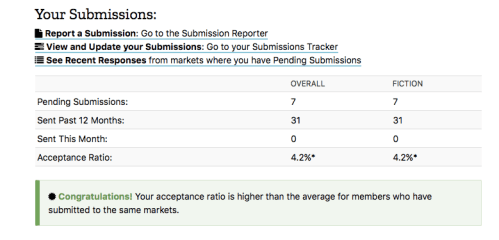
Screen Shot 2018-01-09 at 11.06.26 AM

This is a screen shot from my Duotrope account, which (among other things) tracks submissions. It indicates that of the 31 submissions I’ve sent out over the past 12 months, I have a 4.2% acceptance rate.

Terrible, right? My work must be pretty bad, right? Actually, if you check out the note at the very bottom of this image, you will see that that pathetic 4.2% represents a better than average response rate (from the journals to which I submitted). So much so, Duotrope is congratulating me!

Read the rest of this entry »

Ghostwriting: How does it work?

Ghostwriter 2This is the second installment of a brief series of blog posts relating to ghostwriting. In the first installment, I looked at some common misconceptions about ghostwriting.

In today’s post, I want to dive deeper into a question that can be a bit of a sticking point for many people who are thinking of hiring a ghostwriter.

“How does it work?”

Once you’ve found a ghostwriter and you’re ready to get started . . . well, how do you get started?

There are three main ways that a ghostwriter works with his or her clients. In my experience, writing a book for a client is typically a mix of these three methods, and very rarely is just a single method employed.

Read the rest of this entry »

Ghostwriting: Some Common Misconceptions

Ghostwriter imageOver the next couple weeks, I’m going to be posting some blog pieces covering a part of my career portfolio that I rarely write about: ghostwriting. I have been working as a ghostwriter for the last seven or so years, but due to the nature of the business I have rarely mentioned it here on my blog.

That’s mainly because by nature it’s a fairly secretive process: A ghostwriter is contracted to write a book for someone else, and that person’s name goes on the cover. That’s the deal, with all that it entails: As a ghostwriter, I don’t share credit, my name is never mentioned, and the “author” (my client) proceeds as if he or she wrote the book, from start to finish.

If you look at my ghostwriting page, there aren’t any titles mentioned or links to books. Part of what my clients purchase is my discretion. This can make it hard to market yourself as a ghostwriter, but what would make it really hard is a reputation of blabbing about writing clients’ books. So I keep my silence.

Common Misconceptions About Ghostwriting

In this installment, I am going to look at some misconceptions and points of confusion that I encounter frequently when I talk to people about ghostwriting. My hope is that this might be read by someone bouncing around the internet, trying to decide whether a ghostwriter is what they need for their project. Clearing up some of these misconceptions would make an excellent starting point regardless of the nature of your project.

Read the rest of this entry »

New, tiny fiction

Here is something new for me: I wrote a tweet-length story and it has been published by Tiny Text (@Tiny_Text), a Twitter-based literary magazine that publishes writing of 140 characters or fewer.

My story, “Spoiler Alert,” boils down all stories to a single, tweet-length formula (really).

You can check out the story here, then dive into Tiny Text’s many fine, super-compressed pieces here.

UPDATE: Sadly, Tiny Text is closing its doors, so I’ve captured this screen shot of my story for posterity.

Screen Shot 2018-08-09 at 3.10.10 PM

New fiction at Euphony

I am very pleased and proud to have a short story, “Cruelty,” in the Spring 2016 issue of Euphony, out of the University of Chicago. You can read the story online here.

A little background on this piece. This is all that remains of a novel I wrote during graduate school, then drastically rewrote several times after graduation. That novel (working title: “Isolation Drills”), after lots of reworking, featured a narrator who was making an academic study of pornographic films and who met and began to date a woman. It was a classic first attempt at a novel, with lots of stuff pulled from my life (NOT the porn thing!), not much plot, and some not-very-well-drawn scenes and characters. The whole drafting process was an invaluable study in what’s required for a novel and how to write one (plan! Revise!), but I’m grateful I don’t have to look at or think about those pages anymore.

Even so, the central conflict of the novel and the relationship between the two main characters stuck with me, and at some point last summer I had two related thoughts: “Is there any way I can salvage anything from those multiple drafts and hundreds of pages?” and “What if the perspective shifted from his to hers?”

And so “Cruelty” came to be.

Notes for Next Time

(I was tempted to title this something flashy and contemporary-seeming, like “One Weird Trick to Make It Easy to Jump into Writing,” but opted for the more prosaic title you see above.)

Anyway, a note stemming from last night’s meeting of my “Writing Studio” class at the Pittsburgh Center for the Arts. (Briefly, this is a class whose purpose is to offer writers of all genres/backgrounds the time to write, with some hopefully-stimulating elements like a weekly craft talk, exercise prompts, discussion time, the option to share pages with me and get feedback. Basically, think of an open studio in pottery or painting—it’s like that, but with writing.) Two meetings in, the class has been great fun and very stimulating—for me but, far more importantly, for the students, a number of whom have told me they’ve been enjoying it and getting lots done.

We had a great discussion regarding writing process, and someone brought up Hemingway’s practice of stopping a day’s writing in the middle of a sentence so that he’d have a natural and easy place to start the following day.

This prompted me to share something I do when I stop writing for the day that has come to seem so natural, I quite forgot that I’d ever not done it. The students seemed interested, so I thought I’d share it here as well.

Going off the Hemingway practice, which was designed so that Papa could stop when there was more to be written and it would be fairly clear, the following day, what should come next, I have gotten into the habit of marking the place where I’m going to pick up tomorrow and then writing a short note about what I think can or will happen next.

For example, here’s what I wrote at the end of today’s work on a piece that I think will eventually add up to a novel:

“echoes of Homewood, someone saw him give Malaki a hug and wants a hug too; asks Pete’s advice on Hilda”

This will of course be complete nonsense to you, but it means something to me and when I begin work on this piece tomorrow I can look at this and remember what I thought might be a good next step.

I have the option to follow those notes as if they were a blueprint, but it’s only an option. What I think is important is that these ideas present suggestions I can consider following (and decide to do something else—for instance, I might decide this bit about the hug is stupid, after all, and ignore it), begin to follow and then change course, or follow to the letter if I’m simply not feeling very original (or if I still agree with these ideas).

As I said, this has become a thing I do unconsciously when writing, as ingrained as having a cup of coffee nearby and my internet connection disabled. But several of the students remarked that picking up the thread of a piece of writing often costs them a bit of time and effort each time they get started back up on something, and I remembered that that used to be an issue for me, too. Hopefully this is an idea that can be beneficial to somebody out there.

Runner-Up in Nelson Algren Literary Awards

I’m very pleased to announce that a story of mine, “Klamath Falls,” was named a runner-up in the 2016 Nelson Algren Literary Awards, presented by the Chicago Tribune. Here’s the Tribune story on the contest and the grand prize winner, Lee Conell. Congratulations to Lee as well as the four finalists and three other runners-up!

For their sake, not mine—well, also for my sake if we’re being honest—let me say that this is a big deal. The Algren Awards are deluged with submissions every year, and this year the judges received more than 4,200 entries. To make it out of a pool like that, through multiple rounds of judging, is an accomplishment.

The stories will be published in the Tribune‘s “Printers Row” supplement and online via the paper’s Printers Row app. I’ll post a link when “Klamath Falls” is out there, but Conell’s story appeared this past weekend. Go check it out!

Writing Studio: Slightly shameless plug of an upcoming writing class

Later this summer, I am going to be teaching a class at the Pittsburgh Center for the Arts that I think/hope may be of interest to some of my readers (local ones, anyway).

The class is “Writing Studio” and it’s not so much a class as, well, studio time dedicated to writing (as the name may suggest).

Just as students in other disciplines at the PCA have studio options, and can drop in once or twice a week to work independently with ceramics, screen printing, sculpture, etc., students interested in writing will now have the opportunity to come in to the PCA’s education building once a week and get some writing done.

The class stems from a basic observation I’ve made throughout my courses at the PCA: most of the writers who’ve come through my classes have the most trouble not with point of view, plot, etc., but with the struggle to find time to write and to keep writing (both in terms of keeping their seats during a single writing session and coming back to the writing desk day after day). Building a healthy writing process, and the discipline to keep it up, is among the most pressing challenges for any writer, especially those just getting started. (And working a day job doesn’t make those challenges any easier.)

“Writing Studio” is meant to address these challenges by offering a dedicated chunk of time each week, as well as a space where students can come to work quietly, buoyed by the presence of others doing the same thing. Along with time to write, the course will offer a sense of community and the opportunity to discuss ongoing challenges, troubles, and triumphs. The aim is to give writers time and space to get work done during the five weeks of the course and to launch them into a productive and sustained writing routine long after.

I’ll supplement the core of the course—in-class writing—with writing exercises, craft lectures*, and availability for one-on-one feedback and discussion. But by and large, the class is about giving students a place and a time to come, sit down, and write.

The class runs five Mondays, beginning July 11 and concluding August 8. Each class will run from 6:30 to 9:30 p.m.

If this sounds like something that may be of interest, I hope to see you in July!

*An important note: “Writing Studio” is designed to work for writers in any genre, so readers who don’t write fiction (as I do) may still find something useful in the class, even beyond writing time.

“Scaffolding” in fiction writing

I’ve had the post below saved as a draft for a while, and was inspired to go back to it after reflecting, today, on the conclusion of a really wonderful session of the fiction workshop that I’ve been teaching at the Pittsburgh Center for the Arts over the last two or so years. (Shameless plug: another session of the workshop is starting April 6.)

I like to open each class with some discussion of an open-ended question. I do it because writing is such a solitary art form that a little time to compare notes, commiserate, and try to talk a little about how we do what we do (or what we’re trying to do) can be really important and really encouraging for writers, myself included. Also it’s a great way to ease into class before the students have to hear me lecture on plot, point of view, character, etc.

Some questions are better than others, and last night I came up with a good one: where does meaning—“theme,” that quality in a story of its being “about” something—come from? Do you start out thinking, “This story is going to be about human avarice and greed,” or “I’m going to write a novel about fathers and sons”? Or do you just write, and do something like hope a meaning develops? Or look for meaning only later, when you’ve thrown a few thousand (or more) words on the page?

It was a great discussion, and if there was any consensus it’s that your work will usually surprise you: that fathers-and-sons novel you had planned out so nicely will prove to have little to do with either fathers or sons, and that story where you just thought it would be fun to write about rodeo clowns might prove to have unexpected depths beneath the surface.

In any event, it got me thinking about an experience I had last spring and summer with a pair of stories, about which I started to write a blog post that I never finished. I’ve completed the thought and wanted to throw it out there in case it’s of any use or interest to anyone else in thinking about where not only meaning comes from, but where anything in a story comes from: the act/art of composition and the mystery of it.

Read the rest of this entry »