Adam Reger | Freelance Writer

Philadelphia-based freelance writer

The New Pittsburgh Sandwich

I have been, nominally, a vegetarian for the last ten months. (“Nominally” meaning that I fall off the wagon with considerable frequency.) Of the sacrifices that decision has entailed, there is one that stands head and shoulders above the rest.

I’m talking about the sandwiches at Szmidt’s Old World Deli in the Greenfield neighborhood of Pittsburgh. 

These are consistently among the best sandwiches I’ve had in Pittsburgh or anywhere else. Szmidt’s bakes its own bread and cures its own meat, the lion’s share of what makes their sandwiches so great (and I’m not the only one who thinks so: check out the reviews on Yelp and Urban Spoon).

Here’s their menu:

Image

Some favorites include the Hoya (basically a Reuben), the Kanai (turkey with bacon, cheddar, and garlic mayo), the Emily (turkey, Swiss, and homemade slaw on rye bread), and the Doe Doe (turkey, Swiss, and cranberry vinaigrette on a homemade bun). Their “Cheezers”—grilled cheese sandwiches, basically—are pretty great as well.

(I’d have an even longer list of favorites except that even before going vegetarian, I made it a point not to eat so much red meat, which is why the turkey sandwiches are so heavily represented.)

But the thing that sets Szmidt’s apart, that makes them worth a blog post, is this sandwich of theirs called “The Rage.”

In a nutshell, The Rage is four pierogies, slapped on a homemade bun and topped with other delicious stuff: bacon, cheese, lettuce, tomato, and sauce. If that doesn’t sound quite delicious enough, there’s this: these are special, custom-made pierogies, stuffed with buffalo chicken (the “Buff”), southwest chicken (the “Sanchez”), and beef (the “Philly”). The “Pole-Lock” (formerly the “Pollock”; changed, you would assume, as a concession to general ethnic inclusiveness), is a regular potato pierogi.

I have to confess here I have not tried a Rage in this current four-pierogi iteration: the last time I had one, the sandwich consisted of a single giant, meat-stuffed pierogi with all that other stuff on top of it. There was something really novel and even a bit magical about biting into a sandwich that was built around a giant pierogi stuffed with meat.

Even so, I want to go public with an idea that occurred to me the very first time I bit into a Rage.

This should be the Pittsburgh Sandwich. Not the famous one everyone knows, that is sometimes talked about as if it were to Pittsburgh what the cheesesteak is to Philadelphia, the Chicago hot dog or deep-dish pizza is to Chicago, etc.; the sandwich that’s basically a hunk of meat with French fries and cole slaw piled on top, squeezed between bread; not the one that will give you indigestion for a day and a half, that’s probably only really good if you’re drunk. (I say “probably” because I’ve never had a good Primanti Brothers sandwich, but I’ve also never had one while drunk.)

Forget that other sandwich, and consider the possibilities of this one: Pittsburgh was built on the backs of steelworkers and mill hands who came from all the places across eastern Europe where the pierogi is a staple, where people could get excited about a potato dumpling on a nest of sauerkraut, with a little sour cream or some apple sauce to sweeten the whole package. We’re talking Poles, Slavs, Hunkies, Russkies, Ukies, Serbs, and plenty of others I’m probably missing. Why, this sandwich is nothing less than an homage to Pittsburgh’s culture!

And more than that, here are modern-day Pittsburghers doing something interesting with the pierogi, taking that heritage and reinventing it—just the way the city now is reinventing itself, shrugging off all the rust and depression and harnessing the arts, education, technology, and medicine. 

Here’s a sandwich for the old Pittsburgh—and the new. A sandwich for the Pittsburgh of yesterday and the Pittsburgh of tomorrow; a sandwich that is authentically homemade; a sandwich that tastes good, and that can easily feed two, or make a lunch and a dinner. (This thing is huge.)

What does that other sandwich offer the soul of Pittsburgh? A day’s worth of starch? The sustenance to continue drinking long into the night? Bah! Begone, Primanti’s, you token of a bygone city.

You heard it here first: The Rage from Szmidt’s Old World Deli is the new Pittsburgh Sandwich.

Everyone Has a Song in Their Heart (Another Facebook Note Rescued from Facebook)

Apropos of nothing, except cleaning out my e-mail inbox and coming across a message I wrote myself after reading this in some book on pro wrestling:

[Bret “The Hitman” Hart, speaking to his dead brother Owen at Owen’s funeral]

“. . . Everyone has a song in their heart. Our family’s has always been professional wrestling. The hardest aspect of it was always the never-ending loneliness. In reflection of that, both you and I understood from the very start that we were singing a very sad song. But neither of us, even at this dark hour, are ashamed at having sung that song.”

(This is part three in a series rescuing items I posted long ago as Facebook “Notes,” a feature that time seems to have left behind. Previous items here and here.)

New Favorite Paragraph (a Facebook Note, Rescued from Facebook)

From You Can’t Win by Jack Black. (No, not that Jack Black.) If you’re interested in hobo hygiene, read on. If you like liberal use of quotation marks, friend, read on:

“The ‘Johnson family’ became so numerous that a ‘convention’ must be held. In any well-ordered convention all persons of suspicious or doubtful intentions are thrown out at the start. When a bums’ ‘convention’ is to be held, the jungle is first cleared of all outsiders such as ‘gay cats,’ ‘dingbats,’ ‘whangs,’ ‘bindle stiffs,’ ‘jungle buzzards,’ and ‘scissors bills.’ Conventions are not so popular in these droughty days. Formerly kegs of beer were rolled into the jungle and the ‘punks,’ young bums, were sent for ‘mickies,’ bottles of alcohol. ‘Mulligans’ of chicken or beef were put to cooking on big fires. There was a general boiling up of clothes and there was shaving and sometimes haircutting.”

(This is part two in a series of items posted in the little-loved “Note” feature within Facebook, now rescued for posterity and, hopefully, a larger audience.)

Reason to Love Pittsburgh #8

The “Random Acts of Kindness” column in the Pittsburgh Post-Gazette. I just love it.

For the sappy reasons you’d think, having to do with faith in humanity and the milk of human kindness and so on. But also because there’s such lovely Pittsburgh textures in these messages, and because, if you live here, you can convince yourself these stories wouldn’t be told everywhere else in the world.

Here’s an example, from the March 21st installment:

“Thirty minutes later I realized I didn’t have the [lost credit] card and hurried back to that lane, where I asked the assistant if she had found it. She had not. She directed me to the customer service counter, saying, ‘Don’t worry — this is Pittsburgh!'”

Also to wit, the opener from one of today’s “Random Acts of Kindness”:

“I had occasion to have a buffet luncheon and soft drink at the Pizza Hut located in Brentwood Towne Square.”

Oh, Lord. Oh, Pittsburgh.

P.S. Here is a link with all of the other reasons to love Pittsburgh. There are many more than eight, but I’ve been going slowly.

The Fascinating Case of A.J. Richardson, the Candidate for Mayor of Pittsburgh Whose Face Is Covered in Tattoos

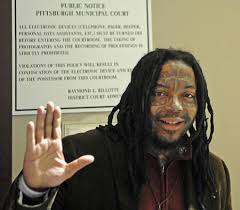
Pittsburgh’s in the midst of a primary campaign for mayor—a Democratic primary, anyway, which in this city is the de facto general election—and so far the greatest storyline to emerge has been A.J. Richardson. He’s originally from Brooklyn, he’s working at present as a bus monitor on the city’s North Side, he’s never held elected office, and, last but not least, his face is covered in tattoos.

Seriously. This is A.J. Richardson:

Image

I’ve mostly been reading about him through mainstream media—here’s a Pittsburgh Tribune-Review profile; here’s a CBS Local piece on how he’s not an underdog; and here’s a Pittsburgh Post-Gazette piece on his decision to plead guilty to DUI charges after a Tuesday night incident—and so I can’t say with any certainty whether or not—

Wait, what? Yep. This tattoo-faced dude was found in a green minivan, engine running, passed out or in a deep stupor in the middle of a road in Pittsburgh’s West End late Tuesday night. Cops honked at the minivan and when there was no answer they pounded on the window. Richardson declined a breathalyzer test but failed the cops’ field sobriety tests. Asked about it the next day, Richardson said the arrest was part of a conspiracy; “It’s a weak, feeble attempt to discredit me.”

I can’t tell if this twist makes me enjoy the A.J. Richardson saga more or less. No one was hurt, but still drunk driving is never funny. But then again it has made it all the more strange to see various media reporting on Richardson’s comments and debate appearances with entirely straight faces.

To be fair, nothing I’ve heard Richardson say is unreasonable. His angle is that he’s never held office, so he’s a fresh voice, will be a fighter for the working man, will sweep out corruption, etc. His campaign website is appropriately vague and positive-minded, and his “Project X”—a plan to ID areas where heavy drug-dealing is happening, to help the police target those areas and not entire communities—is certainly better than some policies.

But man. I just can’t get past those face tattoos. It’s almost like he’s adopted the most extreme body modification I could think of, that is usually associated with white supremacists, prison inmates, rappers with checkered pasts, and basically no one you would characterize as at all wholesome or respectable, and now is also demanding earnest consideration for his adoptive city’s highest office. And, God bless them, most in the media and in the political machinery seem to be doing their best to give it to him.

It’s like everything I love about Pittsburgh is wrapped up in this one news story: weird people, a sort of small-town quality that invites this sort of quixotic campaign, and a widespread niceness, or at least politeness, that has prevented the masses from laughing this guy out of the room.

Anyway, I hope I haven’t been too harsh on him. He seems, on the whole, like a nice guy, and you’ve got to love these kinds of grand, doomed gestures. He has zero chance of winning the Democratic primary, but I’d like to think that the city will measure each candidate by his positions, his record, and his actions, and that it will be these things—his lack of a record or any relevant experience, his unconscionable DUI arrest in the middle of a campaign—that cause him not to be elected, and not all the shit inked into his face.

“Wool” by Hugh Howey

I just finished Wool, by Hugh Howey. I heard about it, and got interested enough to take a chance on it, after reading this Wall Street Journal piece about the book, Howey, and especially the financial and marketing details of the book’s success and of Howey’s deal with Simon & Schuster.

(If the article is paywalled for you, here are the first few paragraphs:

“Hugh Howey’s postapocalyptic thriller ‘Wool’ has sold more than half a million copies and generated more than 5,260 Amazon reviews. Mr. Howey has raked in more than a million dollars in royalties and sold the film rights to ‘Alien’ producer Ridley Scott.

“And Simon & Schuster hasn’t even released the book yet.

“In a highly unusual deal, Simon & Schuster acquired print publication rights to ‘Wool’ while allowing Mr. Howey to keep the e-book rights himself. Mr. Howey self-published ‘Wool’ as a serial novel in 2011, and took a rare stand by refusing to sell the digital rights. Last year, he turned down multiple seven-figure offers from publishers before reaching a mid-six-figure, print-only deal with Simon & Schuster.”)

Now that I’ve finished, I have to say the book’s financial numbers and basic plot—people in a post-apocalyptic future living in a 144-story concrete silo—are the best, most interesting things about it. It’s not a bad novel, but it lacks the polish of traditionally published novels, which for better or worse go through lots of sanitizing and fine-tuning before they’re presented to the public. There’s a flabbiness to the writing that I found distracting, and that diminished my confidence: at a certain point I started skimming scenes with lots of dialogue, knowing by then that the descriptions of the characters moving around the room, gesturing, and so forth, was filler; even the dialogue itself was often redundant, or was too close to the banality of real life to be interesting—it failed the test I’ve learned to apply to most dialogue, which is to ask “How does this push things forward?”

Similarly, the characters are kind of thin, and there are a number of plotlines that Howey periodically forgets about, remembers, and pays brief lip service to before forgetting them again. (As an example, the novel’s central character, Juliette, had a secret, forbidden love interest when she was younger, and until late in the novel he is not given a name, few details are included, and there’s virtually zero reflection on how memories of him or of what happened to him have informed Juliette’s life.)

Some of this is a function of Howey’s writing the book in five parts and publishing each one as it was finished—I don’t doubt that some of Dickens’s serialized novels, much less the pulpier stuff that has been serialized in various publications over the years, have similar problems. And some of my criticisms probably show how little I know about science fiction: I haven’t read anything in that genre in a number of years, but from what I remember from all that I read in middle school and high school, the characterization and the quality of prose in these books are not top-tier concerns for most writers.

Wool is strong on concept, which I do remember being a top-tier concern for sci-fi writers. Howey’s concept is great: history’s been wiped clean, and a few thousand living humans reside in a massive underground silo, where they literally reside on very different social strata: the rulers live “up top,” while the grunts who run Mechanical are in the “down deep.”

Moreover, Howey does something with the silo idea: it’s not just a setting, and he fleshes out the world of the silo to make it rich and specific. I can understand why he’s gained so many favorable reviews on Amazon, and why sales have been so good. (It must be said, too, that the pricing is perfect: after reading the WSJ piece, $6 felt like a fair risk to check this thing out.)

The most favorable thing I can say about Wool is that it ought to make a great movie some day: the concept is great, and the characters Howey’s chosen should form a good foundation for a talented screenwriter to take the story the rest of the way: to give the characters that extra dimension, perhaps even to modify the plot so that things are clearer, the action more compelling. (There are what feel like a few aimless sections, errands that make sense to me as a writer—“He’s moving Juliette here so that she can return to this room in order to find _______”—but that feel unsatisfying as a reader.) It should also be a pretty cheap movie to film, considering that it would be hard to film the entire silo at once; as a film producer, you’d be left with nothing but sets, the most expensive of which would seemingly be a tall staircase. (There are no elevators in this grim vision of the future. In fact, one of the cooler elements was the “porters” who ran messages and goods up the stairs, presumably developing massive, mutant quadriceps muscles, though Howey doesn’t tell us that.)

While I found Wool a little disappointing as a piece of fiction, having known some of the backstory added an element of interest that really enriched the experience. I kept wondering what marked the book as having been self-published; many times, I compared some of Howey’s writing to what I’ve seen in undergraduate and graduate fiction workshops, and imagined what my peers would have said if I’d submitted something with this sentence, or failed to describe this character’s face, clothes, or backstory. I ended up feeling that Wool was not an especially great book, but that it was transcendent as a self-published book: for having not had to pass any filters, but to have risen by reputation and quality, is an achievement, and while I may have found fault with the novel, I can see why Wool has earned this achievement.

Update: Interesting and insightful blog post by Allen Watson that suggests (while making some larger points about self-publishing) that my disdain toward self-publishing tainted this review. I have to say I don’t see it—if anything, I think there is more disdain toward science fiction in this post—but maybe a critic can’t see his own biases.
True stories of the clueless

Right off, I’ll warn you that this is going to be a bit meaner than many of my previous blog posts. But I believe the joy I take in this person’s failure is well-earned, in this case.

Here’s the background: I administer the social media accounts for a large university. It’s fun: my job is to post things several times a day on Facebook and Twitter, and to some extent to engage with people on those sites. What’s more, I’ve got some flexibility and I’m able to come up with ideas, implement them, and get the immediate gratification (or, sometimes, the lack of it) of getting “likes,” retweets, and appreciative comments (or, again, snarky comments).

A case in point was this Monday. It was April 1; i.e., April Fool’s Day. I had what I thought was a great idea for a post. I worked on doctoring up a photograph on Friday and would periodically think about this joke throughout the weekend, sort of chuckling to myself.

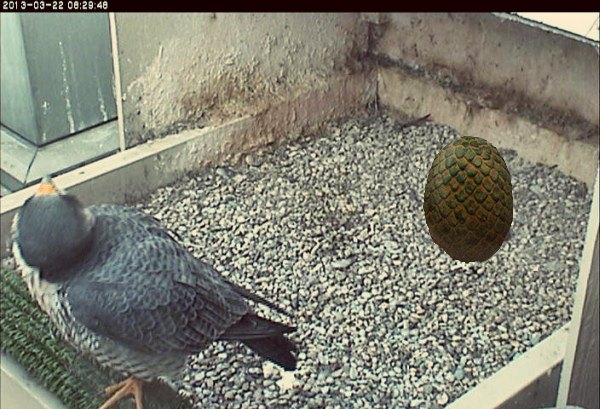
(Very briefly, yet more background: at this large university, there is a very tall, gothic-looking building where a couple of peregrine falcons like to nest. There’s a webcam set up on them, and lots of great photos have been appearing over the last week (like this one, taken from the great “Outside My Window” bird blog) as one of the falcons has been laying her eggs for the year. It’s been great fodder for Facebook and Twitter, and I’ve milked it to the fullest extent.)

The idea was the image you see below: Dorothy, the new mother, having laid one additional egg: a dragon’s egg, from Game of Thrones (which, neatly enough, had had its season 3 premiere the night before).

7687_10151391467268182_98333682_n

Is it great Photoshopping? Of course not. But is it fun? Certainly.

So, cut to the purpose for my writing this. Several hours later, several dozen “likes” and retweets and friendly comments in, the comment in the following photo appears. (The names of certain people have been blacked out to protect them in their naivete.)

Dum dum 2 fixed

In case you can’t read it, the person writes, “nice joke, SET THE BIRD FREE!”

There are great responses in the rest of the comments, most asking, “Is that an April Fool’s joke, too?” One or two people pointed out that, what, this bird is totally free already. Then, some wonderful person pointed out what I had realized, but didn’t dare mention in my capacity as account administrator: this commenter had several weeks previous made the same comment, demonstrating an apparent belief that this photo shows a peregrine falcon in a dingy cage, for some reason enslaved by the major research university and elite public educational institution that employs me. (For the record, via the National Aviary, here is a web cam with more information about the whole set-up. Suffice it to say, these falcons are quite literally as free as birds.)

I could not resist clicking the person’s name to find out what his/her deal was. Lo and behold, I found the image below:

Dum dum 1 fixed

The person shared the photo on his/her own Facebook page, with a message reading, “To all my fellow animal activists will you send [the name of the university (written incorrectly, I can’t help pointing out)] a little message about the importance of freedom, look at where they have this noble creature!”

Oh, dear God.

I shouldn’t jump on this person too much, because one of his/her friends later commented that it appeared the peregrines were free indeed, and just perched in this spot, and the person basically acknowledged this. But come on. There is something about someone jumping to a conclusion like this, granting zero credit and being so swift to be outraged, that their being mistaken and my having the opportunity to revel in it is just. Irresistible. That it was all unfolding on April Fool’s made it that much sweeter and more poignant.

Kurt Vonnegut’s 90th

Today would have been Kurt Vonnegut’s 90th birthday. I’m not usually one for celebrating hypothetical birthdays (Vonnegut died in 2007), but by coincidence today I came across this post, written for Hot Metal Bridge‘s blog while I was a graduate student at the University of Pittsburgh. It could be more concise, but I remember well the incident described in the post, and am still charmed by the whole encounter.

Football Mailbag Item Demonstrates Something about the Varied Nature of Humankind

I am a habitual reader of Peter King’s “Monday Morning Quarterback” column on si.com; in fact, it often disrupts my Monday morning routine when I’m not able to dive into writing before the new column is posted. It’s Monday, and there’s a new column up, but I want to draw attention to an item in last week’s “Tuesday Morning Quarterback” (a follow-up column with additional items, stuff pertaining to that week’s Monday night game, and a reader mailbag) before it’s lost on the internet forever.

I don’t really have anything to say about this or to add to what King writes. It’s just . . . interesting. Here goes:

“WELL, THIS IS AN INTERESTING TAKE. ‘I apologize for the rant but after seeing Arian Foster from the Texans looking like a baby bird getting fed by its mother when getting water I couldn’t hold it back anymore. I’m tired of watching football player standing there and letting someone squirt water in their mouths both on and off the bench. I know there are going to be a lot of reasons (time, face mask etc…) put out there. But for me those can be left at the door. Might as well turn in your man card if you need someone to squirt water in your mouth. Not sure why this bugs me so much. Am I the only one?’
— From Murray Galbraith, of Shawnigan Lake, British Columbia

“I believe so.”

Morning Fog

It is a foggy morning in Pittsburgh. As is always the case when fog is general across the city, I am reminded of one of my favorite short stories, Tobias Wolff’s “Our Story Begins.” The story’s setting is San Francisco, and the fog is a bit more aggressive than it is here this morning, but what lovely descriptions:

“The fog blew in early again. This was the tenth straight day of it. The waiters and waitresses gathered along the window to watch, and Charlie pushed his cart across the dining room so that he could watch with them as he filled the water glasses. Boats were beating in ahead of the fog, which loomed behind them like a tall, rolling breaker. Gulls glided from the sky to the pylons along the wharf, where they shook out their feathers and rocked from side to side and glared at the tourists passing by.

“The fog covered the stanchions of the bridge. The bridge appeared to be floating free as the fog billowed into the harbor and began to overtake the boats. One by one they were swallowed up in it.”

. . .

“Charlie started home the long way, up Columbus Avenue, because Columbus Avenue had the brightest streetlights. But in this fog the lights were only a presence, a milky blotch here and there in the vapor above. Charlie walked slowly and kept to the walls. He met no one on his way; but once, as he paused to wipe the dampness from his face, he heard strange ticking steps behind him and turned to see a three-legged dog appear out of the mist. It moved past in a series of lurches and was gone. ‘Christ,’ Charlie said. Then he laughed to himself, but the sound was unconvincing and he decided to get off the street for a while.”

Copying out these passages, I was struck first that these aren’t actually flamboyantly beautiful descriptions of fog; second, that they’re sneakier and more effective than that, because what they conjure up is the sensation you get when you’re trapped or enveloped in fog: in the first two paragraphs, Wolff describes a bus boy inside a tourist-trap restaurant as the fog closes in, strangling business for the evening; in the last, the bus boy walks home alone, late, through the fog and the empty streets. The three-legged dog is not Wolff’s usual thing—he’s a more realistic, generally unsentimental writer, not given to quirks or humor other than the dry sort—but here it makes sense: strange things come out of the fog, and everything looks a bit stranger when its context is wiped away. You can read metaphorical significance into the fog, isolating the main character, Charlie, forcing him to confront his own life—but you don’t really need to; it’s fog, it’s San Francisco.

I can remember reading “Our Story Begins” for the first time and getting chills. It was the summer and I was sitting in a laundromat in Philadelphia, waiting for my load of wash to be done. Walking around the city I had picked up a book called Graywolf Annual for some year, maybe 1989 or ’90, in a box of books put out on the curb with a placard reading “Free Books!” There were a number of fantastic stories in that collection—Andre Dubus and Richard Ford were represented, along with Annie Proulx’s “The Half-Skinned Steer”—but “Our Story Begins” was the one that made me put the book down, look around, and feel obscurely that I had been taught something important and at just the right time. I was older than the main character—23 or 24 at that time—but in not so different a place in terms of life and career. In the story, Charlie is revealed to be an aspiring writer who has moved to San Francisco with thoughts of Kerouac, of Allen Ginsberg or Gregory Corso popping into the cafe where he goes to escape the fog; his novel, we’re told, has been returned without comment by all the publishers he’s sent it to—except for one, who’s written “Are you kidding?” across the title page. Without encouragement, friendless, with San Francisco’s long, cold summer wearing him down, Charlie is just on the point of giving up. His encounter in the cafe, listening in on an ambiguous conversation between a married couple and the choir director the wife is having an affair with, sustains Charlie, convincing him to push on a little further by conveying a sense of possibility, of wonder at what the world will turn up next. It was an immensely encouraging idea to read in a story; whether or not any of this happened to Tobias Wolff, it seemed impossible he hadn’t lived some version of this pivotal moment, deciding whether to go on.

I’ve already sort of spoiled the story for you, but below the jump is its conclusion—a big part of why I’ve remembered this story so fondly for so long: Read the rest of this entry »