Adam Reger | Freelance Writer

Philadelphia-based freelance writer

Rad Website Alert

Today I came across MFA Dayjob, a pretty new site that speaks to an issue I’ve been very interested in, to varying degrees, since the time I started applying to grad school: work, and what kind of work graduates of MFA writing programs do to keep themselves alive; more specifically, what kind of work that is not teaching.

I felt surprisingly exceptional among my MFA program peers when I’d say that I was not interested in teaching, but expected to have some kind of office job, or to make a living as a freelance writer and editor. (NB: Time is having its joke on me, as I’m now pursuing more teaching opportunities.) Having existed outside the teaching economy (so far), I can say the main employment-related benefit to having an MFA has been the leg up it’s given me on BA-possessing English majors; that benefit hasn’t been anything a driven, competent, even brown-nosing recent (BA) graduate couldn’t have equaled through his/her own talents and ambition, however.

Anyway, today’s installment is an interview with Erin Fitzgerald, who edits the Northville Review 
(which published my story “Santo vs. Crushing Grief”). She also wrote one of my favorite stories ever to appear during my time as fiction editor of Hot Metal Bridge, wittily and weightily taking on the cute but in practice seemingly impossible theme of “Headless.” Also, via this interview, I’ve learned she attended Sarah Lawrence College, which is where I started my own post-secondary education.

Anyway, good luck to MFA Dayjob, which fills a very specific niche but one that I think fascinates a vast number of writers.

Signifying Either Nothing or Everything about America Today

Just one day after I wrote this, about a news story that was basically a novel in capsule form, came the news of the three Cleveland women found alive and escaping from a rundown house where they’d been kept captive for about a decade. I imagine somewhere book deals, television rights are being discussed right now, if they have not been finalized, and there are certainly novel-length accounts of the case to be written.

I don’t have anything particularly novel or insightful to add to the story, except to note the weird (or not weird at all, maybe) pervasiveness of fast food restaurants in this story.

For your consideration:

Charles Ramsey, the man who saw Amanda Berry crawling out of the house and went to her aid, said when interviewed, “I heard screaming. I’m eating my McDonald’s. I come outside. I see this girl going nuts trying to get out of the house. I go on the porch and she says, ‘Help me get out. I’ve been here a long time.’”

This was certainly well-noticed on Twitter, where enough people tweeted at McDonald’s that they’ve announced they will “reach out” to Ramsey, whatever that means.

But there’s also the fact that Amanda Berry was abducted at age 16 in 2003 after returning from working a shift at Burger King.

And among the details that have come out subsequently are the seemingly inevitable recriminations and clues missed. One of these pertains to warning signs about Ariel Castro, the man who owned the house where the women were kept captive, and who has been confirmed to be the father of the six-year-old girl found inside the house. In 2004, Castro was suspended from his job as a bus driver for 60 days after leaving a four-year-old boy on his bus for several hours. From the Wall Street Journal: “The report, which doesn’t make clear who called, alleged that Mr. Castro told the boy, ‘Lay down, b—,’ while he went to eat in a Wendy’s restaurant.”

So there you have it. Fast food is somehow intimately connected to this case. Perhaps the hormones in the beef patties affected Ariel Castro’s judgment, or some additive in the McDonald’s Ramsey was eating gave him the momentary courage to—

Nah, not really. Poor neighborhood, cheap and admittedly tasty food, fat nation. Case closed.

But as a writer, it’s hard not to see these details in news stories and think of them as perfect, crucial details that lend texture and atmosphere to the depictions of reality—and of class, especially, in this case—the journalists present. You might knock a fiction writer in this instance for going back to the same well one or two too many times. But in nonfiction terms, these details are superb at telling us something about the world and times we live in.

Free Box #5: Old Testament Beard, Where Have You Been All My Life?

“Old Testament Beard, Where Have You Been All My Life?” is the title of my undergraduate thesis in creative writing. I’m alarmed to find it’s more than 10 years old.

It was doing absolutely nothing, hanging out in a filing cabinet, so since I have a scanner and a website, I thought I’d post it. It’s quite a bit of writing, especially for an undergrad: 60 pages comprising two stories, three poems, one essay, and a tough-to-define thing that I guess you could call a story. (It’s text that was screen-printed onto a t-shirt as part of a group art project; see the very last page of the document and decide for yourself.) I’ve improved as a writer since then, certainly, but I remain fairly proud of a lot of this writing

Anyway, here’s Old Testament Beard Where Have You Been All My Life?.


Feet of clay; or, “Plantar fasciitis sucks”

I’ve been weirdly heartened, the last week or so, to hear that Joakim Noah, center for the Chicago Bulls, has been suffering from plantar fasciitis for the last couple weeks. “Plantar fasciitis sucks,” Noah said. “It feels like you have needles underneath your foot while you’re playing.”

Heartened not because I dislike Noah; he’s one of those pain-in-the-ass players whose yelling and physical defense would bug the hell out of you if he were going against your team, but who you’ve got to be happy to have on your side.

Rather, heartened because I’ve been dealing with plantar fasciitis for about 18 months, off and on, and it’s sort of nice to see it getting some attention.

Some time in the fall of 2012 I started noticing that the sole of my right foot would hurt when I first started to run, and often in the morning. I didn’t know enough to stop running, or even run less frequently, and anyway the pain usually stopped once I’d gotten into a run. I kept running until some time in October, when I went to the excellent Fleet Feet running store in Pittsburgh’s South Hills and they suggested I try some various calf stretches.

I did, to no effect. Over the next few months I’d go to a podiatrist, then go back to Fleet Feet for some shoe inserts. The 2012 Pittsburgh Marathon bib I’d bought some time before was sold on race weekend to an out-of-town runner. Six months later, the 2012 Philadelphia Half-Marathon bib I’d bought many months before I passed on to my sister.

Significantly, I am writing about plantar fasciitis all these months later because of my own stupidity and impatience. I’d heard good things about CrossFit, and there was a gym near my office, so I signed up. I loved it, and didn’t pay too much attention to the impact of Olympic-style weightlifting on my foot and Achilles. The CrossFit gym I went to offered a running class that taught the Pose method of running, and I went to that as often as I could manage. I figured I was pretty much back to normal, if I was doing CrossFit and running, so I began doing occasional running workouts at an indoor track: sprints, intervals, barefoot running, even backward running.

Some time over this past winter I decided I was kidding myself if I thought CrossFit and running were not bad for my foot. I went to a physiatrist and was prescribed six weeks of physical therapy. I did that. I’ve gotten inserts in my shoes, have been faithfully doing the stretches my physical therapist recommended, and as often and for as long as I can I sleep with my right foot in a brace to gently stretch the plantar fascia.

The results are, at best, middling. The thing that really sucks about plantar fasciitis is how sensitive it is even when you do all the right things. I’ve been doing home workouts over the last two and a half weeks that have involved things like jumping jacks, jogging in place, just to warm up. Those have tweaked my foot; it hurts as much now as it did the day I stopped running. I am inching toward a Cortisone shot and, beyond that, toward surgery. The notion of surgery seemed like a joke when the physiatrist suggested it: he made a point of saying that he did not recommend it, and I made a point of letting him know I wanted to avoid surgery if at all possible. It’s weird to acknowledge but it’s gone on long enough now that I’m in a place where I wouldn’t dismiss surgery out of hand. The idea of running again isn’t even particularly in my mind, either. It’s just a matter of being able to walk for a long time without the certainty that it will aggravate my foot, and down the road of being able to do a workout where I jump, or lift weights standing up, or run from home plate to first base.

A lot of bellyaching, I know. But this is just to substantiate Noah’s statement, a true one, that plantar fasciitis sucks.

Update: It’s almost a year later but I am back to fairly normal health, foot-wise, and have just posted an extremely lengthy account of how I got there.

Novel idea expressed as a paragraph in a news story

You may have seen this story, about a Pennsylvania woman who disappeared, was declared dead, and subsequently turned up in Florida.

I’ve been fascinated by it, and in particular the impetus for the woman’s, Brenda Heist’s, disappearing in the first place. Here’s the Associated Press’s account:

Heist was going through an amicable divorce in 2002 when she got some bad news about future housing plans, Schofield said. She was crying in a park when some strangers befriended her, then invited her to join them as they began a monthlong hitchhiking journey to south Florida, he said.

I don’t mean to minimize the heartache Heist caused her husband and children, but—doesn’t that sound kind of magical? Friendly strangers comfort you as you cry in a public park, and on a whim you decide to change your life completely. Wow. If I were casting about for a new fiction project to start on, I would have just found it. The themes would be the tenuousness of modern life, this American willingness to throw everything aside and start over, the adaptability of personality. Stuff like that.

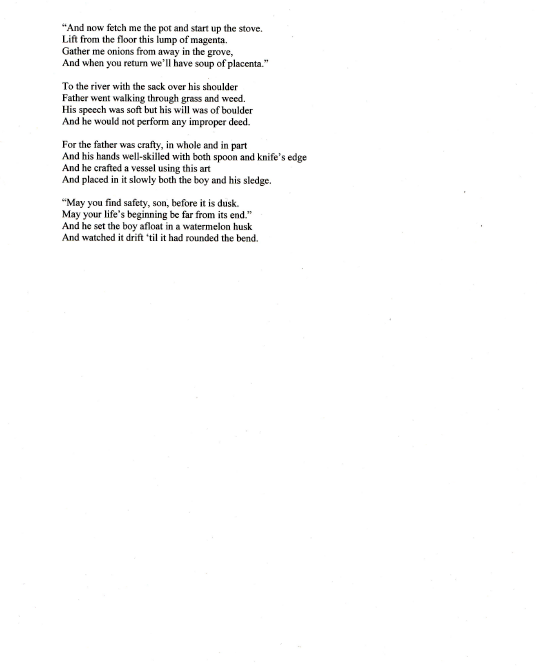
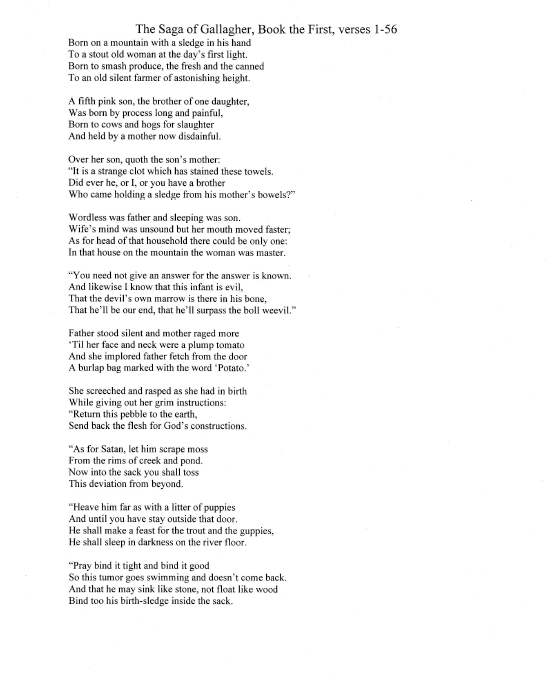
Free Box #4: “The Saga of Gallagher, Book the First, Verses 1-56”

Nothing I can say about this one will adequately prepare you for what a weird piece of writing this is.

. . . Except maybe the fact that I wrote it for a poetry slam at Sarah Lawrence College in the spring of 1999, and “performed” it by putting the pages inside the biggest, oldest-looking book I could find in the library, and read to the (pretty large) audience as if reading from some ancient tome.

And also that, yes, it is about that Gallagher, the watermelon-smashing comedian. (Here is a phenomenal review of an ill-advised Spanish language show Gallagher put on some time ago.)

Anyway, beside that, there’s nothing I can really say. Here’s the poem:

Image

Image

The still unceasing wonder of the internet

In a coincidence too noteworthy not to write about, yesterday, just several hours after I posted this, about the subject of a blog post finding and commenting on said blog post, I logged into my Facebook account and saw this:

Image

Someone at Szmidt’s saw this post I wrote about them.

The unceasing wonder of the internet (and Reason to Love Pittsburgh #11)

. . . exists, among other places, in the fact that sometimes your blog subjects write back. And are completely kind and nice about it.

In the comments of that piece today, I found Billie Nardozzi had written in! Just go to the above link, scroll down to the comments, and experience my unfolding wonder as it happened.

This brings me to my Reason to Love Pittsburgh #11: people here are really, really nice. Like continue-to-surprise-you-with-their-niceness nice. (I had the idea recently for a mural (or a t-shirt, a bumper sticker, or whatever), in the vein of Austin, Tx.’s “Keep Austin Weird,” that would read “Keep Pittsburgh Polite.” I still think it’s not a bad idea.)

The Occasional Review, Volume I, Issue 1

An interesting thing about online literary magazines is that there’s no significant difference between a link to a certain short story or poem in the table of contents and a link from Twitter, or a blog, or the author’s home page—you click the link, you go there. I’ve always thought it would be cool to “edit” a “journal” from all the other journals. I envisioned giving my “journal” a distinctive color scheme, a signature font, etc.

Well, I never got around to doing all that. But I did collect a number of pieces I quite admired. So in the spirit of sharing, and pursuing goals no matter how half-assedly, I give you The Occasional Review, Volume I, Issue 1.

TABLE OF CONTENTS

“A Good Deuce” by Jodi Angel

“Fairytale of New York: The story behind the Pogues’ classic Christmas anthem” by Dorian Lynskey

“2 Good 2 Be 4Gotten: An Oral History of Freaks and Geeksby Robert Lloyd

“How to Hack Chipotle” by William Hudson

Steve Albini integrates the history of music fads into his hate for Cher’s ‘Believe'” by Marah Eakin

Book Shopping with the Best-Read Man in America” by John Lingan

“The Forgotten Actress as Isadora Duncan in Russia” by Bridget Lowe

“Why white critics’ fear of engaging Tyler Perry is stifling honest debate” by Joshua Alston

“Confessions of a New Coffee Drinker” by John Friedman

“Haircut” by 5secondfilms.com with Thousands of Internet Commenters

The Gun Nut Graf

Lest you think I’m about to get all political, this is more a post about rhetoric and the state of the gun debate than it is about the substance of the gun debate.

In journalism there is what’s called the “nut graf,” containing the essence of the story, its reason for being newsworthy.

Recently I’ve noticed, in reading the occasional story about a gun rights rally, a public forum, or just a story about the gun-control debate, that there will often appear what I will (suavely) call the “gun nut graf”: a single paragraph where the person asserting his (and it has so far always been his) Second Amendment rights goes beyond what any reasonable interpretation of the Second Amendment would grant, and/or beyond any reasonable interpretation of recent gun-control legislation in this country, to assert something that shows the speaker to be, yes, a gun nut.

To clarify, I’m not talking about someone yelling, “What part of ‘shall not be infringed’ don’t you understand?” I am talking about rhetoric way beyond that. Let’s consider two examples:

Here’s the lead paragraph of a story on a Westmoreland County commissioners meeting:

Westmoreland County commissioners unanimously approved a resolution Thursday that supports the U.S. Constitution and the Bill of Rights, a move that gun rights supporters said didn’t go far enough.

Got that? The Constitution and Bill of Rights—soft on our Second Amendment rights.

And from this story, about a gun-rights rally in Harrisburg:

“We haven’t stopped fighting,” said state Rep. Daryl Metcalfe, R-Cranberry. “We’re continuing the effort to regain our freedom of areas that they’ve infringed our rights in the past.”

As I said, I don’t want to get political, but this is an example of rhetoric shaping reality. Gun-rights advocates have won. (Here’s Wayne LaPierre bragging about it.) In his first term, Barack Obama’s only gun-related action was to allow gun owners to carry weapons in state parks. No one on the gun control side of the debate is even talking about handguns, much less hunting rifles; gun-control advocates, with half a dozen massacres fresh in the collective memory, have struggled and so far failed to get an anodyne background-check bill, something a reported 90% of the public supports, passed in Congress. We are in this position, as far as the debate terms being what they are, because gun owners have never ceased being convinced that someone wants to take their guns away, that they must continue fighting for rights that others not only would take, but in the past have taken, from them. Your opponent is curled up on the sidewalk, begging for mercy, gun lobby. Stop fighting already.